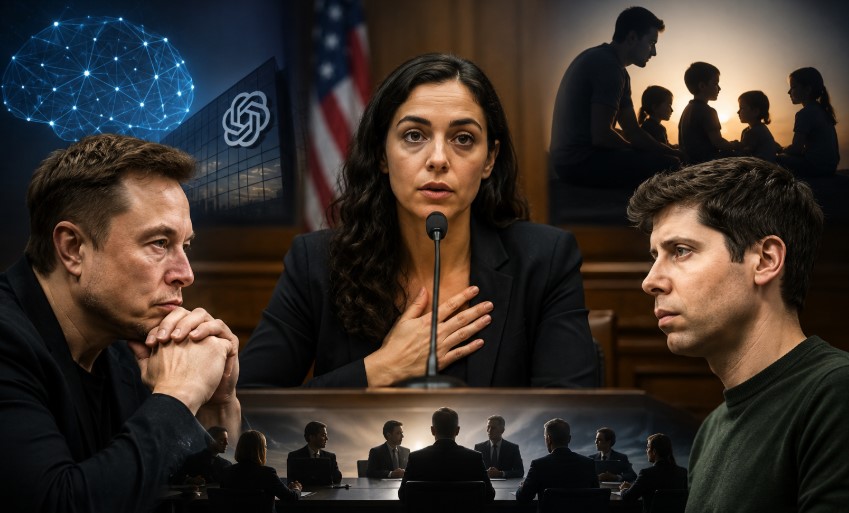
What began as a courtroom battle over artificial intelligence quickly turned into one of Silicon Valley's most personal revelations.
On the sixth day of the landmark Musk v. Altman trial in Oakland, California, the world learned that an Elon Musk sperm donation was at the origin of one of tech's most quietly guarded relationships. Shivon Zilis, former OpenAI board member, Neuralink executive, and mother of four of Musk's children, took the witness stand on Wednesday and offered testimony that no observer had fully anticipated.
Who Is Shivon Zilis?
Zilis is not a peripheral figure in this story. She is, in many ways, its quiet center.
A Yale graduate and Canadian-born technology executive, she joined OpenAI as an adviser in 2016, the same year she first connected with Musk. By 2020, she had become the youngest member of OpenAI's board of directors, a position she held until 2023. She has also worked across Musk's empire, including stints at Tesla and Neuralink, the brain-implant startup where she remains an executive today.
Her personal and professional lives, it turns out, have been deeply intertwined for nearly a decade.
The Testimony That Stopped the Room
In federal court, Zilis described a relationship with Musk that unfolded in stages over several years.
It began, she said, with "a one-off" at a corporate off-site event. Later, after she had made the decision to become a single mother and was dealing with health issues, Musk stepped forward with an offer. She testified that he "offered to make a donation" as a platonic sperm donor. She accepted.
She and Musk had, she said, "agreed on complete confidentiality" about the arrangement due to security concerns surrounding the billionaire. Her reasoning was straightforward: "If he was indeed just a donor, it didn't seem fair to put that burden on them."
Zilis only disclosed the relationship to OpenAI's board after Business Insider informed her it planned to publish a story. That detail alone speaks volumes about the culture of secrecy operating at the highest levels of the AI industry.
Over time, she testified, the arrangement evolved. She and Musk now share what she described as a romantic partnership, and Musk is an active presence in the lives of their four children, spending time with them each week.
Loyalty, Conflict, and a Loaded Text Message
The courtroom was equally focused on whether Zilis had served as a back channel between Musk and OpenAI after his 2018 departure from the board.
A 2018 text message she sent to Musk became a centerpiece of questioning. In it, she wrote: "Do you prefer I stay close and friendly to OpenAI to keep info flowing or begin to disassociate? Trust game is about to get tricky."
When asked by Musk's attorney Jennifer Schubert whether it was her job "to funnel information to Elon," Zilis was direct: "Funnel? Absolutely not."
She later clarified her phrasing in the message, saying: "I would have preferred it if I'd written 'trust framework,'" rather than "trust game."
Meanwhile, Greg Brockman testified the day before that Zilis had told him in 2021 she was pregnant with twins but did not name the father. He said he discovered who it was through media reports. After internal discussions, the OpenAI board voted to let her remain. "We actually had a board vote and decided to let her stay. We trusted her to keep the Elon conflict under control," Brockman said.
The Bigger Battle: OpenAI's For-Profit Transformation
Behind the personal drama lies a high-stakes corporate war.
Musk is suing Sam Altman and Greg Brockman, alleging they betrayed OpenAI's founding mission as a nonprofit dedicated to the benefit of humanity. He claims his roughly $38 million in early donations were used for unauthorized commercial purposes. OpenAI, now valued at over $850 billion by private investors, has called his allegations baseless.
From the stand, Musk said he started OpenAI to serve as a "counterweight" to Google. He has since founded xAI, his own competing AI venture, and led a $97.4 billion bid to acquire OpenAI in early 2025, which Altman immediately rejected.
"I had an allegiance to the best outcome, AI for humanity," Zilis testified, insisting that neither her personal relationship with Musk nor her professional loyalties affected her judgment as a board member.
Why This Testimony Matters to the AI Industry
Zilis's testimony is significant well beyond the headlines it will generate.
It reveals how deeply personal relationships have shaped the governance of the world's most consequential AI company. It raises serious questions about conflicts of interest, board oversight, and the concentration of influence among a tiny circle of powerful individuals. And it underscores how the decisions made inside these elite networks affect technologies that billions of people now use every day.
The trial continues, with the liability phase expected to conclude by May 21.
A story that began inside an AI courtroom has now become a global conversation about power, privacy, and the personal lives shaping the future of artificial intelligence.

Comments (0)
Leave a Comment
No comments yet
Be the first to comment