
When a government packages constitutional reform as a political manoeuvre rather than a national compact, it invites the very defeat that the 2026 Parliament Expansion Bill ultimately suffered. The episode is a lesson in the limits of legislative arithmetic without moral authority.
The defeat of the Constitution (Amendment) Bill on delimitation and parliamentary seat expansion in early 2026 was, on its surface, a story about numbers. The government had failed to secure the requisite two-thirds majority in both Houses of Parliament. But to reduce it to arithmetic would be to misread what the episode actually represented. This was a fundamental breakdown in the political consensus that constitutional amendments, by their very nature, demand. It was not merely a legislative loss. It was a moment that exposed the deepening fault lines in India's federal architecture, the fragility of the ruling coalition's political calculus, and the enduring tension between the imperatives of representational equity and the democratic principle of proportional legitimacy. What collapsed was not just a bill but the ambition to reshape the very grammar of Indian parliamentary democracy without the trust that such a grammar requires.
The Constitutional Vision Behind Delimitation
Delimitation, the process of redrawing electoral constituency boundaries and redistributing parliamentary seats, is among the most consequential and politically charged exercises in any democracy. In India's case, it is embedded in the Constitution's architecture as a mechanism to ensure that electoral representation keeps pace with demographic reality. The number of Lok Sabha seats has remained frozen at 543 since the delimitation exercise of 1971, a deliberate policy decision codified through the 42nd Constitutional Amendment in 1976 and subsequently extended. The logic at the time was straightforward. Rewarding states with higher population growth by giving them more seats would create a perverse demographic incentive, discouraging family planning efforts in states that were earnestly pursuing population stabilisation.
That freeze, however, was always intended to be temporary. With India's population having more than doubled since 1971 and now crossing 1.4 billion, the average Lok Sabha constituency today represents more than 2.5 million citizens. That figure strains any credible theory of representative democracy. In countries with comparable or smaller populations, parliamentary bodies are considerably larger. Proponents of expansion had a legitimate and constitutionally coherent argument. A Lok Sabha of 850-plus seats would bring India closer to an internationally reasonable legislator-to-citizen ratio, allow more granular geographic representation, and, critically, enable the implementation of the Women's Reservation Act of 2023, which had made reservation contingent on the completion of delimitation.
The Government's Proposal
The government's proposal, as introduced in the winter session and subsequently brought to a vote in 2026, envisaged a substantial expansion of the Lok Sabha from its current 543 seats to approximately 850, with a corresponding increase in Rajya Sabha representation. Constituencies were to be redrawn using the 2021 census data, reflecting population distributions that had shifted significantly in the five decades since the last full delimitation. At the procedural level, the proposal was sound. The demand for expansion was backed by demographic evidence and electoral administration arguments that few could credibly dispute.
What made the proposal instantly contentious was the explicit linkage it established between the delimitation exercise and the implementation of women's reservation. The Women's Reservation Act, passed with considerable political fanfare in September 2023, had reserved one-third of Lok Sabha and state legislative assembly seats for women. Its implementation, however, was deferred to a future delimitation. The government's 2026 bill thus presented delimitation not merely as an administrative necessity but as the gateway through which women's reservation would become operational, binding the two reforms together in a single constitutional package.
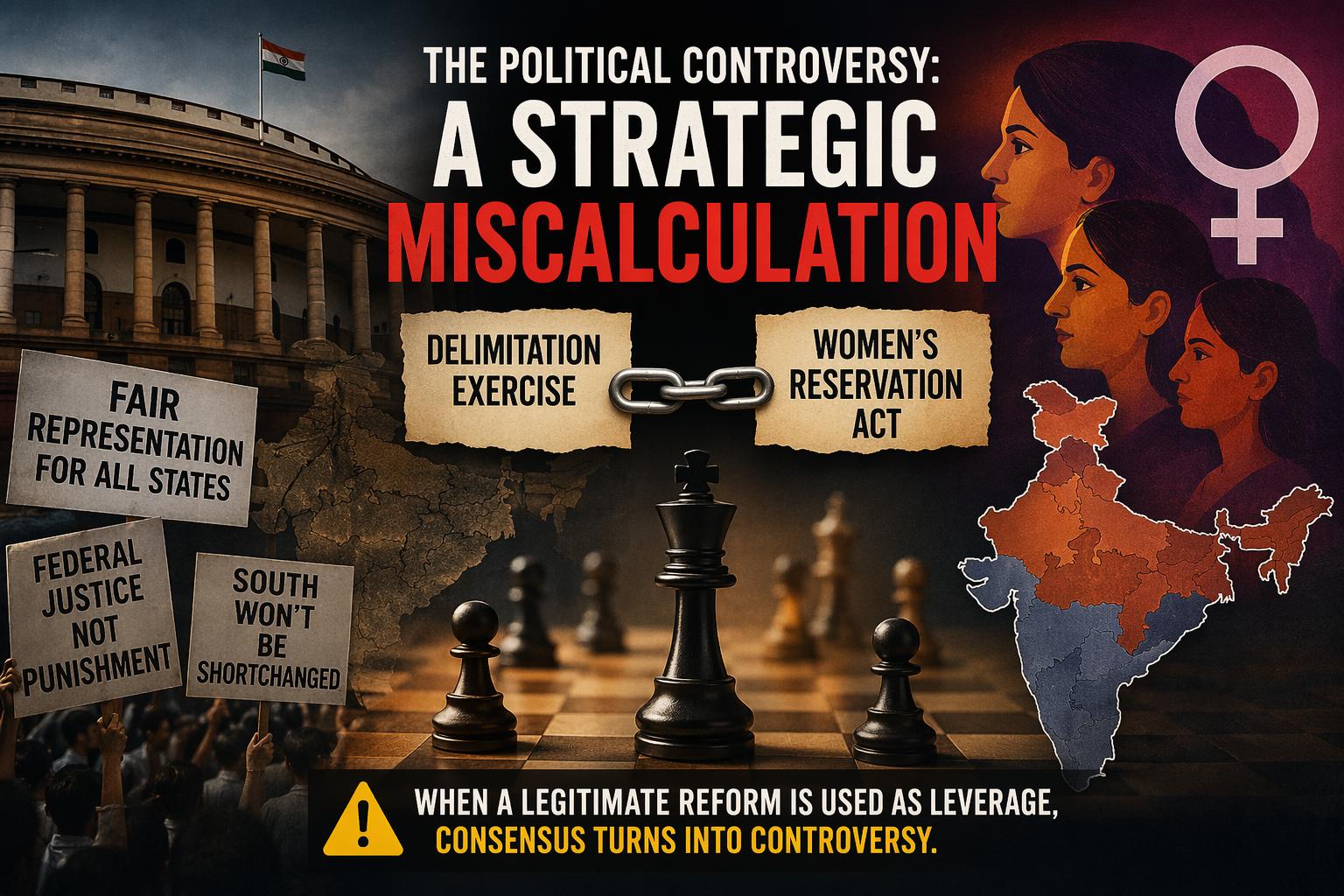
The Political Controversy: A Strategic Miscalculation
It is at this juncture that the government's legislative strategy drew its sharpest criticism. Many constitutional observers argued that merging the Women's Reservation framework with the contentious delimitation exercise reflected one of the most politically risky legislative strategies in recent years. The Women's Reservation Act had, at the time of its passage, achieved something rare in contemporary Indian politics: cross-party support and genuine public enthusiasm. It was a moment of political consensus, however fragile, built on the moral authority of a long-overdue reform. To reintroduce women's reservation into parliamentary discourse through the back door of delimitation, an exercise loaded with interregional rivalry and federal suspicion, was to jeopardise the goodwill that the earlier legislation had generated.
"Opposition leaders characterised the move as an example of aggressive political maneuvering that prioritised electoral advantage over consensus-building, a criticism that framed the decision as one of the government's most questionable political calculations."
The accusation was substantive, not merely partisan. Critics within the constitutional law community noted that women's reservation and delimitation are analytically separable. Reservation could, with appropriate statutory ingenuity, be made operational within the existing 543-seat framework pending a full delimitation. The government's insistence on linking the two suggested, to many observers, a strategic design. By making women's reservation contingent on delimitation, the ruling dispensation sought to pressure opposition-governed southern states into acquiescing to a seat expansion exercise they fundamentally opposed. Southern states, particularly Tamil Nadu, Kerala, Karnataka, Andhra Pradesh, and Telangana, had expressed clear reservations about the exercise. Forcing them to choose between opposing delimitation and being seen as obstructing women's reservation was widely read as a cynical use of a legitimate social reform as political leverage.
"To reduce women's reservation to an instrument of delimitation politics was to betray both the reform and the women it was meant to serve."
Federal Anxiety: The North–South Divide
The deepest fissure that the bill exposed was not partisan but federal. Southern states have, since the 1970s, pursued aggressive policies in education, public health, and family planning. The result has been a demographic dividend of a different kind: slower population growth, higher per capita income, and better development indicators. Under a population-based delimitation using 2021 census data, states like Uttar Pradesh, Bihar, Rajasthan, and Madhya Pradesh, where population growth has been considerably higher, would gain a disproportionately large share of new Lok Sabha seats. Southern states, by contrast, would see their share of parliamentary representation diminish relative to the expanded house, even if their absolute seat count remained stable or marginally increased.
This is not an abstract concern. In a federal democracy where resource allocation, from central taxes to finance commission devolution, is influenced by political bargaining power, losing relative representation in the Lok Sabha carries real fiscal consequences. Southern chief ministers were vocal about what they termed a punishment for development. States that had responsibly managed population growth would effectively subsidise northern states' growing demographic weight with legislative seats. The fear was legitimate, the political frustration palpable, and the government's response, largely framed in the language of national democratic reform rather than federal accommodation, did little to allay it.
Parliamentary Defeat: Numbers and Fallout
Constitutional amendments in India require approval by not less than two-thirds of the members present and voting in each House of Parliament, in addition to a simple majority of the total House membership. This is a deliberately high threshold, intended to ensure that fundamental changes to the constitutional framework enjoy broad political legitimacy rather than merely reflecting the will of a momentary majority. The government, while commanding a majority in the Lok Sabha, found itself unable to reach the two-thirds mark in the Rajya Sabha, where the combined weight of regional parties from southern and eastern India, aligned with the principal opposition bloc, proved decisive.
The immediate fallout was significant. The bill's failure triggered not just the withdrawal of the delimitation proposal but placed the implementation timeline of the Women's Reservation Act in deeper uncertainty. Opposition parties, including those that had vocally supported women's reservation in 2023, found themselves in the uncomfortable position of being criticised for blocking a reform they had previously championed, while simultaneously arguing, with considerable justification, that the government had structured the bill in a manner designed to make their opposition politically costly. The political optics were bruising for both sides, though the reputational damage fell more heavily on the ruling dispensation, which had authored the legislative architecture that produced the impasse.
Institutional Consequences
The failure of the bill carries institutional consequences that extend well beyond the immediate electoral cycle. The delimitation exercise, regardless of its federal controversies, is a constitutional necessity that cannot be indefinitely deferred. The Election Commission of India operates constituencies drawn on half-century-old population data, creating gross imbalances in voter representation across constituencies within the same state. The longer delimitation is delayed, the more these imbalances compound, eroding the democratic legitimacy of the electoral process itself.
More immediately, the women's reservation question has been returned to a state of legislative limbo. The Act exists on the statute books. Its implementation remains contingent on a delimitation that is now further away. The women who stood to benefit, particularly from marginalised communities whose representation in Parliament has historically been among the lowest, are the ultimate institutional casualties of a political miscalculation they had no hand in making. Future efforts to disentangle the reservation question from the delimitation imbroglio will require not just legislative creativity but the kind of political goodwill that this episode has substantially depleted.
The Larger Democratic Lesson
What this episode ultimately teaches is a lesson that India's constitutional history has offered before, though political establishments have shown a persistent reluctance to internalise it. Constitutional amendments are not ordinary legislation. They require, beyond the formal threshold of a two-thirds majority, something more elusive and more important: a shared sense among political actors across party and regional lines that the proposed change serves the national constitutional compact rather than a particular political interest. When that sense of shared ownership is absent, even the most numerically attainable supermajority evaporates.
The risks of combining unrelated reforms, namely women's reservation and parliamentary seat expansion, in a single constitutional package were visible to any careful political analyst well before the bill was introduced. That the government chose to proceed regardless suggests either a misreading of the federal mood or a deliberate calculation that the political cost of failure was acceptable compared to the potential gain of success. In either case, the judgment proved faulty. Constitutional reform demands not speed but depth, not tactical advantage but institutional trust. Where trust is thin, substantial parliamentary arithmetic cannot substitute for the legitimacy that consensus provides.
"In constitutional democracies, numbers alone do not guarantee reform; legitimacy flows from consensus, restraint, and political wisdom qualities that were notably absent in this episode."




Comments (0)
Leave a Comment
No comments yet
Be the first to comment