"This Issue Has Put a Line Through the Conservative Movement"
A Conference That Cannot Hide Its Fractures
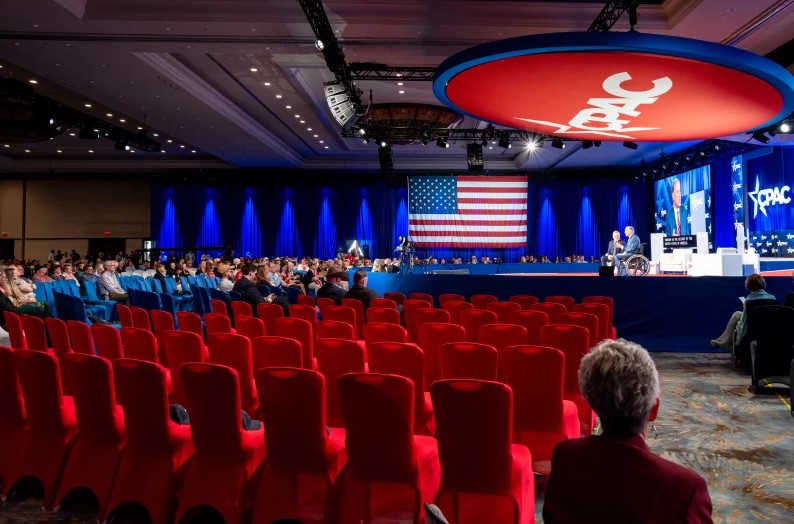
The CPAC 2026 Iran war divide announced itself not from the podium but in the hallways, side conversations, and interviews with attendees across a dozen age groups.
A generational divide over the Iran war surfaced between older attendees and their political heirs at CPAC 2026, as the group's leaders pleaded for unity in a challenging midterm election year for Republicans.
CPAC has long been a gathering of conservative triumphalism. In recent years, the conference has served as a showcase for Trump's movement, a place where the base refuels before the next campaign cycle. This year was different from the moment it opened.
Tiffany Krieger, a 20-year-old sophomore at the University of Pittsburgh, said her onetime level-10 support for Trump has dipped to five over the war. "It seems like the love for him is plateauing. We see our party splitting apart and we're supposed to be united. I think this issue with the war has put a line through the conservative movement."
That is not a disaffected Democrat speaking. That is a self-identified Trump supporter, at the most prominent annual gathering of the American right, using the word "line" to describe what the Iran war has drawn through her own political identity.
The Two Conservative Worlds Inside the Same Conference Hall
Young Conservatives: "This Is Not What We Voted For"
The generational divide at CPAC 2026 is not abstract. It is specific, documented, and grounded in a collision between what Trump promised in his campaigns and what he has done since February 28.
"We did not want to see more wars. We wanted actual America-first policies, and Trump was very explicit about that," said Benjamin Williams, a 25-year-old marketing specialist for Young Americans for Liberty. "It does feel like a betrayal, for sure."
Auburn University sophomore Sean O'Brien's support for Trump has slipped, especially with talk of sending US troops into the Middle East. "I'm not happy," he said. Sending troops into Iran, he said, "would be full betrayal."
Matthew Kingston, 26, of Lubbock, Texas, was more direct: "I personally don't think we should be getting involved in Iran. This is definitely not what I was voting for when I voted Trump. This was supposed to be America first, not Israel first."
Older Conservatives: "He Did What He Had to Do"
The older cohort at CPAC offered a structurally different reading of the same events. For them, Trump's campaign rhetoric about ending foreign wars was never a commitment to absolute non-intervention. It was a critique of incompetent intervention.
"I don't believe he started a new war. He was acting in response to a 40-year-old war by Iran," said 70-year-old retired defense contractor Joe Ropar of McKinney, Texas. "How long were we supposed to wait? I think he did what he had to do when he had to do it."
This framing, Iran as the aggressor in a multi-decade confrontation finally brought to its conclusion, reflects how the administration itself has tried to contextualise the strikes. The problem is that younger conservatives are not persuaded by it.
"We Cannot Divide From Within": The Leadership Plea That Revealed the Depth of the Problem
CPAC's Own Stage Acknowledged What Its Programme Tried to Smooth Over
Mercedes Schlapp, senior fellow for the CPAC foundation, opened Thursday's session with a direct appeal from the stage: "We cannot divide from within. Let's stay united. They want us divided."
The appeal was necessary precisely because the division was visible and growing. CPAC chairman Matt Schlapp took a more candid position.
"Any consensus is still to be determined. I think people trust President Trump, so I don't think there's been any shaking of his support," Schlapp told the Associated Press. "But I think underneath there's concern about where does this lead."
"Where does this lead" is the question structuring every conversation at CPAC 2026. The US military is preparing to deploy at least 1,000 troops from the 82nd Airborne Division to the Middle East. The Pentagon is moving additional assets into the region. Trump has said Iran should "get serious soon, before it's too late." The possibility of a ground offensive, which O'Brien described as "full betrayal," is no longer theoretical.
Erik Prince's Warning and Steve Bannon's "Peace Room"
The Right's Own Security Establishment Breaks Ranks
The most striking floor moment at CPAC 2026 came not from a student or an anonymous attendee but from Erik Prince, founder of the private military company formerly known as Blackwater, a figure with direct operational experience in Middle Eastern conflict.
Prince issued a stunning warning to the CPAC crowd: "You will see imagery of burning American warships in the next couple of weeks." He warned that few militaries in history have had success conquering Iran, saying: "I don't share the optimism of the administration that there's going to be a peaceful stop to this."
Steve Bannon brought his skepticism to CPAC in a speech cheekily labelled "Peace Room," telling the crowd: "It's a debate that has to happen. Our sons, daughters and grandchildren could soon be sent to the frontlines."
When two of the most prominent figures associated with Trump-era hawkishness are raising alarms about an open-ended Middle Eastern conflict, the political significance is difficult to overstate. This is not the opposition party. This is Trump's own intellectual base questioning the direction of a war he launched.
The Polling Paradox: Strong Republican Support, Fragile Coalitions
80 Percent Approval That Hides a Structural Vulnerability
A recent Pew Research Center survey found nearly eight in 10 Republicans approve of Trump's handling of the war. However, that support drops substantially when looking solely at younger Republicans and conservative-leaning independents, two groups that Trump made significant gains with in 2024.
This is the statistical architecture of the divide. The 80 percent headline approval number tells one story. The crosstabs tell another.
Younger Republicans and conservative-leaning independents were central to Trump's 2024 electoral coalition. They delivered margins in key swing states. If the Iran war erodes their enthusiasm into 2026 midterm season, the downstream consequences for House and Senate races could be severe, exactly the scenario that former Republican National Committee chairman Michael Whatley warned about from the CPAC stage.
Conservative pollster Richard Baris said fewer young voters are identifying as MAGA, a phenomenon the Iran war has accelerated. Young people are far more skeptical of Israel than bedrock Republican voters, and the Trump administration has done little to counter the view among some critics that Prime Minister Benjamin Netanyahu is leading the US into another open-ended Middle East conflict. "There's a resentment now with younger Republicans toward Israel because they feel like the US put Israel before them," Baris said.
The Absent President and the 2028 Question
Who Holds MAGA Together When Trump Is Not in the Room?
Trump's absence at CPAC this year is a reminder that he may be the only figure that holds large parts of the party together. When he is not there, it is unclear who fills that role.
The 2028 straw poll results released on the conference's final day showed pronounced splits on who the base would like to see as the GOP presidential nominee, confirming that no single successor has consolidated the coalition.
Younger attendees predicted significant political fallout for Republicans ahead of November. "In the midterms, I think the GOP is going to get destroyed," said Hayden Harms, a 21-year-old student at Dallas Baptist University. The party is "on its last leg" unless it adapts to a new generation of voters, he added.
That prediction may be too stark, but the underlying political logic is sound. The Trump coalition was built on three pillars: economic nationalism, immigration restriction, and an explicit rejection of foreign military adventurism. The Iran war has placed the third pillar under sustained pressure from within the coalition itself.
Conclusion: CPAC 2026 Iran War Split Is the Most Important Story American Politics Is Not Discussing Enough
The CPAC 2026 Iran war divide is not a fringe story. It is a leading indicator. What happened in Grapevine, Texas, this week documented in real time the early stages of a coalition fracture that could reshape Republican electoral math ahead of November 2026.
The older conservatives who see Iran as a necessary reckoning and the younger conservatives who see it as a betrayal of the movement's founding promise are not talking past each other. They are having a genuine argument about what America-first politics actually requires.
That argument will not be resolved at a conference. It will be settled, at least partly, by whether American troops enter Iran, whether Bannon's prediction of burning warships materialises, and whether Trump delivers an economic outcome that gives the coalition something to rally around beyond the war.
May 4 decides West Bengal. November decides Congress. And somewhere between now and then, the MAGA movement must decide what it actually believes about foreign wars.


Comments (0)
Leave a Comment
No comments yet
Be the first to comment