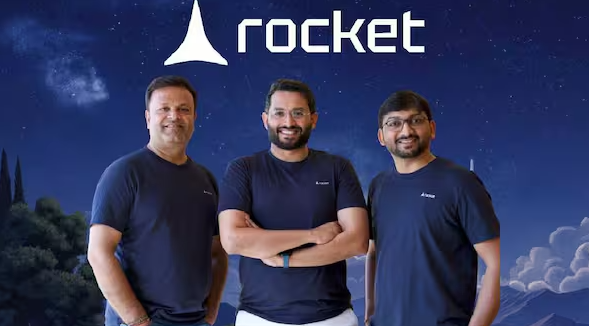
Indian AI startup Rocket, the Surat-based platform that turns plain-language prompts into production-ready applications, is targeting a $50 million Series A round at a $500 million valuation. The raise would mark a more than threefold increase from the company's implied valuation at its $15 million seed round closed in September 2025. It would also put Rocket among a fast-growing list of sub-$1 billion AI startups competing directly against well-funded Western platforms like Lovable, Replit, and Cursor.
The story of Rocket is not just a funding story. It is a case study in how the global center of gravity for developer tooling is shifting.
What Rocket Actually Builds and Why Investors Are Paying Attention
Most AI coding platforms generate quick prototypes. Rocket does not compete on that dimension. The startup launched Rocket 1.0, a platform that connects research, product building, and competitive intelligence in a single workflow, generating detailed product strategy documents that include pricing, unit economics, and go-to-market recommendations.
CEO Vishal Virani frames this as solving what the company calls the "Day-Two problem." The pitch is specific: most web coding tools create a dazzling demo and fall apart once real users arrive. Rocket's answer is "vibe solutioning," blending the speed of natural language prompts with the discipline of production engineering.
The numbers since the September 2025 seed round support that thesis:
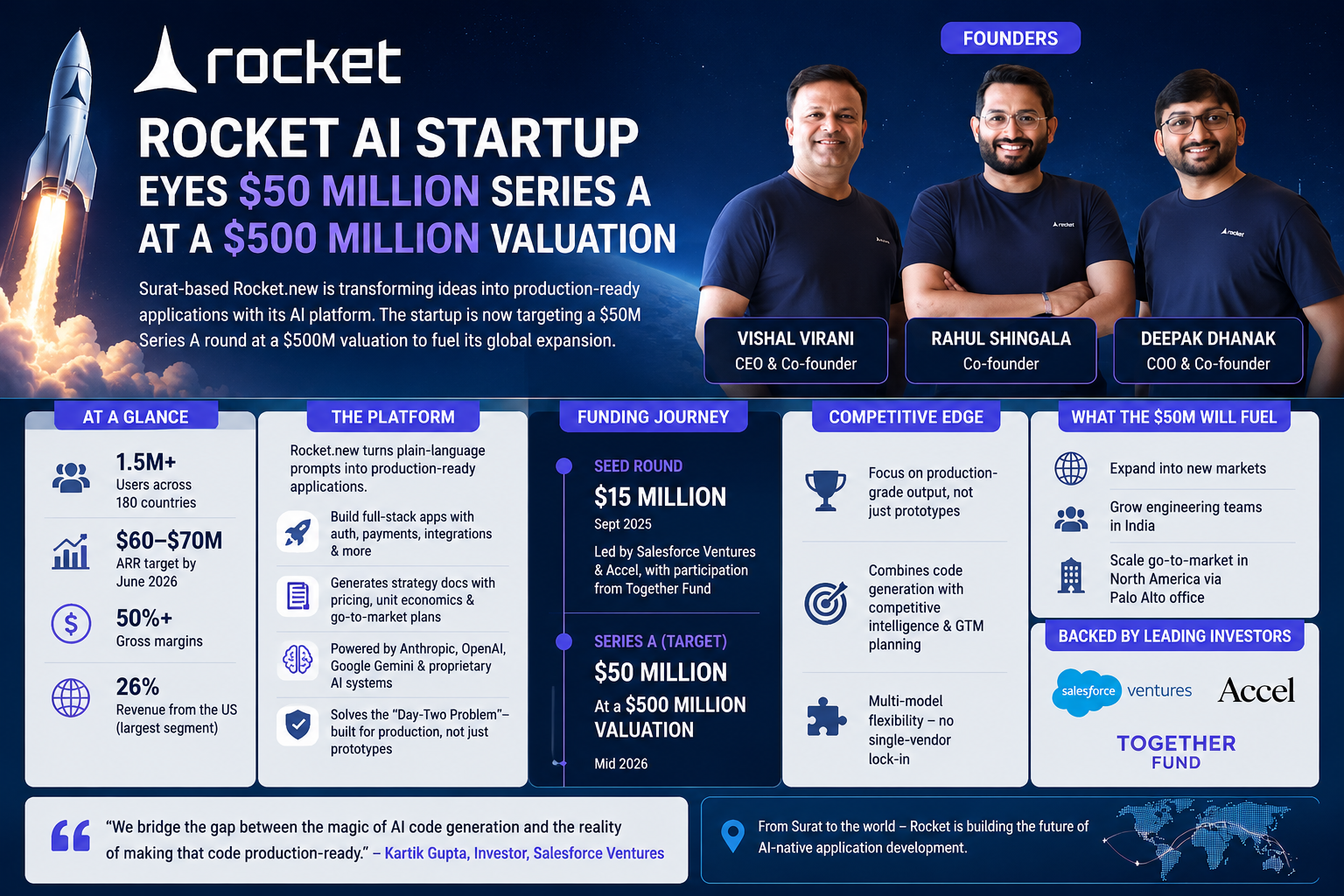
- Rocket has grown from 400,000 to over 1.5 million users across 180 countries.
- The startup reported an annualized average revenue per user in the $4,000 range.
- Gross margins sit above 50%, with 20% to 30% of customers being small and medium-sized businesses.
- The US is the largest revenue segment at 26%, followed by Europe at 15-20% and India at 10%.
Those margins are not typical for early-stage AI startups. Most are burning heavily on GPU costs. Rocket's ability to maintain 50%+ gross margins while scaling rapidly is the metric most likely to attract institutional investors at Series A.
The Seed Round and Who Backed It
Rocket raised $15 million in seed funding led by Salesforce Ventures and Accel, with additional participation from Together Fund. The funding was set to fuel research and development, accelerate product innovation, and support global expansion including the establishment of a North American headquarters in Palo Alto, California.
Salesforce Ventures investor Kartik Gupta described the company as solving a clear gap between the magic of AI code generation and the reality of making that code production-ready.
That framing matters. Enterprise buyers do not want prototypes. They want deployable software. Salesforce's involvement is a signal that this platform has genuine enterprise potential, not just developer hobbyist appeal.
The Competitive Landscape and What a $500 Million Valuation Actually Implies
The vibe coding market has become crowded quickly. Lovable crossed $100 million in ARR. Replit and Cognition have billion-dollar valuations. Cursor dominates developer mindshare among technical users. Emergent, another Indian startup, raised $23 million in Series A led by Lightspeed.
So why would investors price Rocket at $500 million when the seed round valued it at a fraction of that?
The answer lies in growth rate, ARR trajectory, and differentiation. Rocket.new set a target of $60 to $70 million in ARR by June 2026, up from $4.5 million in September 2025. If that trajectory held even partially, the revenue multiple implied by a $500 million valuation is aggressive but not disconnected from comps in this market.
Three factors distinguish Rocket from most competitors:
- It targets production-grade output, not prototypes, which justifies enterprise pricing.
- It integrates competitive intelligence and go-to-market planning alongside code generation.
- It was built on LLMs from Anthropic, OpenAI, and Google's Gemini combined with its own deep learning systems, giving it model flexibility rather than single-vendor dependency.
What the $50 Million Would Fund
Co-founder and COO Deepak Dhanak said the company intends to continue building product capabilities, expand into new markets, and use the Palo Alto office as a gateway to Silicon Valley's enterprise ecosystem where demand for AI-native application building tools remains strong.
Based on Rocket's current headcount trajectory, the capital would likely accelerate engineering hires in India and go-to-market investment in North America and Europe.
Why This Raise Matters Beyond Rocket's Own Balance Sheet
There is a broader policy and market context here that deserves attention.
In Q1 2026, AI captured $242 billion in global venture funding, representing 80% of total global venture investment, compared to 55% in Q1 2025. The market is not cooling. It is compressing: capital is concentrating at the frontier model layer while a parallel wave of application-layer startups competes for the remaining appetite.
Rocket's Series A falls into that second wave. It is not building a foundation model. It is building a workflow layer on top of existing models, which is lower risk from an infrastructure standpoint but faces commoditization risk if the underlying LLM providers build similar tools natively.
The India Angle Is Not Incidental
Co-founder Dhanak noted that the investment highlights increasing global investor interest in India-founded technology companies building for a worldwide audience.
Rocket is headquartered in Surat, a city known for diamond and textile industries rather than technology development, and positions itself outside India's traditional tech centers of Bengaluru, Hyderabad, and Mumbai.
That geography matters for policy analysis. India's government has made AI a national priority, with regulatory frameworks and startup incentives increasingly aligned to capture a larger share of global developer tooling revenue. A Surat-based company raising at a $500 million valuation from Silicon Valley investors is precisely the kind of outcome that validates those policies.
What Happens Next
The round has not formally closed. If Rocket hits its ARR targets and completes the raise, the next question is whether an IPO pathway opens in 2027 or whether the company becomes a strategic acquisition target for a larger enterprise software vendor seeking an AI-native development platform.
Either outcome would represent a significant milestone for Indian deep-tech in the current cycle.


Comments (0)
Leave a Comment
No comments yet
Be the first to comment