More than a year after the World Health Assembly adopted the WHO Pandemic Agreement, the treaty still cannot be signed by a single country. The reason lies in one unfinished piece, a system meant to guarantee that when a country shares a dangerous pathogen with the world, it gets fair access to the vaccines and treatments built from that data in return. Whether that system will actually work is the question shaping global health diplomacy right now.
What the WHO Pandemic Agreement Actually Promises
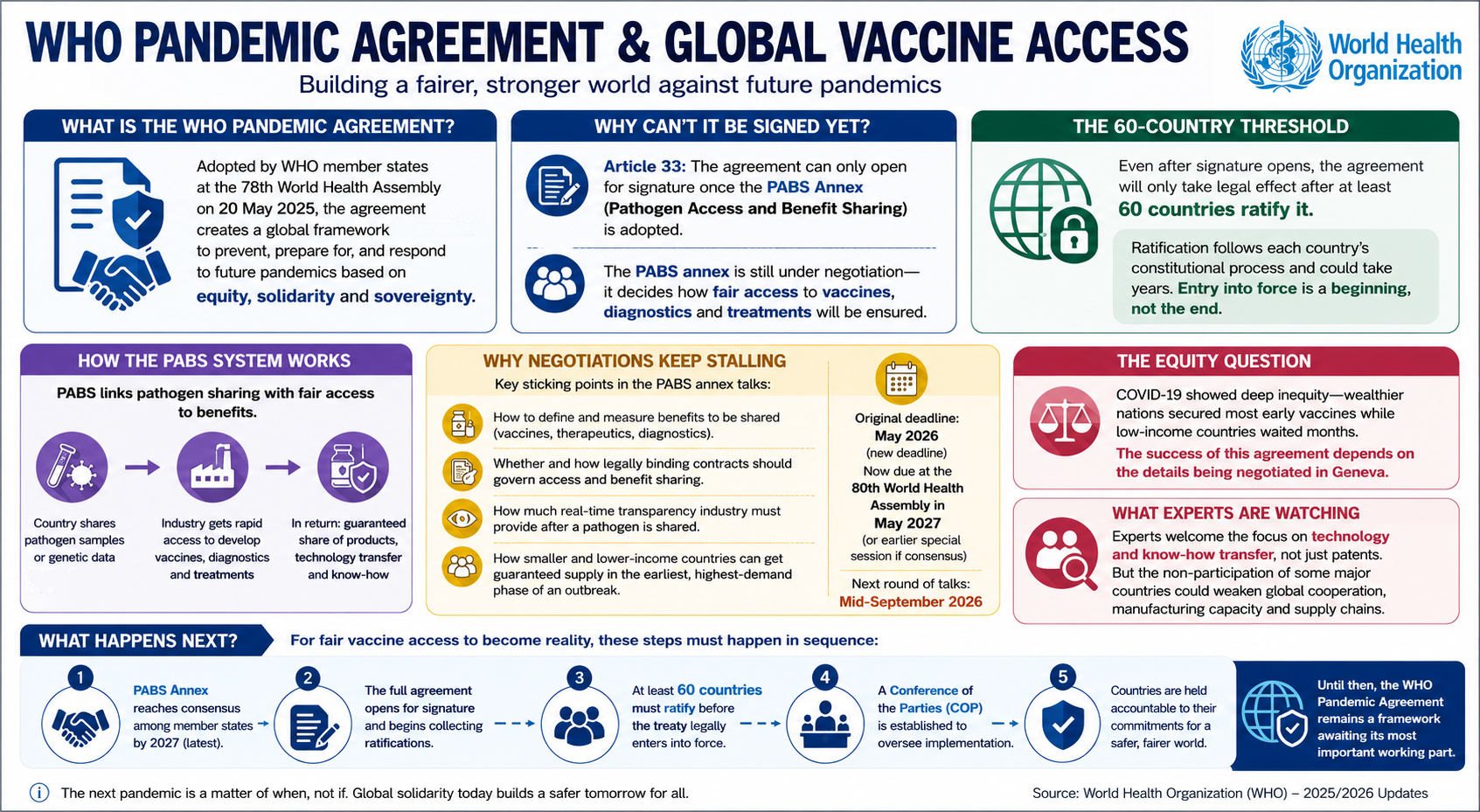
The Pandemic Agreement was formally approved by WHO member states at the 78th World Health Assembly on 20 May 2025, closing a three year negotiation triggered by the failures exposed during COVID-19. The treaty sets out a shared framework for preventing, preparing for, and responding to future pandemics, built around equity, solidarity, and respect for national sovereignty.
Why the Agreement Cannot Be Signed Yet
Adoption of the text was not the finish line. Article 33 of the agreement states that it can only be opened for signature once a separate annex on Pathogen Access and Benefit Sharing, known as PABS, has also been adopted by the World Health Assembly. That annex is still being negotiated, and it is the part of the deal that determines whether vaccine access will actually be fair.
The 60 Country Threshold
Even after signature opens, the agreement will not take legal effect until at least 60 countries ratify it, a process that follows each nation's own constitutional procedures and could take years to complete. Ratification does not create an automatic obligation to implement every provision immediately, which is part of why public health experts describe entry into force as a beginning rather than an endpoint.
How the PABS System Is Meant to Work
The Pathogen Access and Benefit Sharing mechanism sits at the center of the fairness question, because it links two things that have historically been disconnected: who shares outbreak samples and genetic sequence data, and who benefits from the products made using them.
Rapid Access in Exchange for Guaranteed Benefits
The system is designed so that when a country facing an emerging outbreak shares a pathogen or its genetic sequence, industry gets rapid access needed to develop vaccines, diagnostics, and treatments. In return, that country and others facing similar risk are supposed to receive a guaranteed share of the resulting products, along with technology transfer and practical know-how rather than access on paper alone.
Why Negotiations Keep Stalling
Progress has been slower than planned. Member states missed the original May 2026 deadline to finalize the PABS annex, prompting the Assembly to extend talks for up to a year, with the outcome now due at the 80th World Health Assembly in May 2027 or an earlier special session if consensus is reached sooner. Negotiators met again in July 2026 and made headway on some of the most technically and politically difficult elements, according to the Intergovernmental Working Group's co-chairs, though core disagreements remain unresolved. Key sticking points include:
- How to define and measure the benefits that must be shared, including vaccines, therapeutics, and diagnostics.
- Whether and how legally binding contracts should govern access and benefit sharing between countries and manufacturers.
- How much real-time transparency industry must provide once a pathogen sample is shared.
- How smaller and lower income countries can be guaranteed supply during the earliest, highest demand phase of an outbreak.
The eighth round of talks is scheduled for mid-September 2026, and WHO Director-General Tedros Adhanom Ghebreyesus has urged negotiators to treat the remaining gaps with urgency, noting that the next pandemic is a matter of when, not if.
The Equity Question at the Heart of the Debate
Fair access has been the agreement's founding promise since the earliest COVID-19 vaccine shortages, when wealthier nations secured the bulk of early doses while lower income countries waited months longer. Whether the finished treaty delivers on that promise depends on details still being fought over in Geneva.
What Public Health Experts Are Watching
Researchers studying the agreement's implementation point to a gap between the treaty's stated principles and the environment it will operate in. The text explicitly identifies technology and know-how transfer, not patents alone, as essential to genuine equity, which marks a shift from earlier global health frameworks. At the same time, analysts note that the nonparticipation of some major countries in the process risks fragmenting private sector cooperation and global manufacturing capacity, potentially weakening the very supply chains the agreement depends on.
What Happens Next
For fair vaccine access to become more than a stated goal, several things need to happen in sequence:
- The PABS annex must reach consensus among member states, expected no later than the 2027 Assembly.
- The full agreement must then open for signature and begin collecting ratifications.
- At least 60 countries must ratify before the treaty legally enters into force.
- A Conference of the Parties must be established to govern implementation and hold countries accountable to their commitments.
Until each of those steps clears, the agreement remains a framework awaiting its most important working part.



Comments (0)
Leave a Comment
No comments yet
Be the first to comment