Why West Bengal Election 2026 Is a National Inflection Point
West Bengal election 2026 is not just another state assembly contest. It is the most closely watched political battle in India this year, contested across 294 seats, fought between two of the country's most organised political machines, and generating national headlines days before a single ballot is cast.
West Bengal Assembly elections are scheduled in two phases on April 23 and April 29, 2026, with counting on May 4. A total of 70,459,284 voters are eligible, including 36,022,642 male and 34,435,260 female voters.
Both the ruling Trinamool Congress and the opposition BJP have submitted full candidate lists, launched parallel campaigns in north and south Bengal respectively, and drawn their battle lines on fundamentally different terrain. TMC is running on welfare, identity, and incumbency. BJP is running on governance failure, border security, and accountability.
The result on May 4 will shape not just Bengal's next five years but the national political calculus ahead of the 2029 general elections.
"The People Know the Truth": TMC's Campaign Architecture
Mamata Doubles Down on Welfare as Her Core Identity
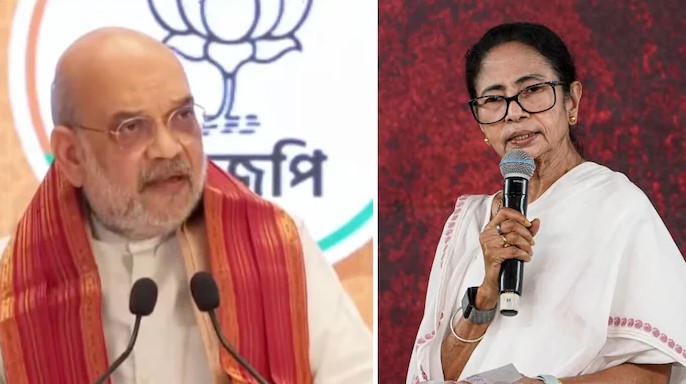
Chief Minister Mamata Banerjee unveiled the TMC's manifesto on March 20, 2026, announcing 10 pratigyas at a press conference and touting the Duare Chikitsa doorstep healthcare programme as one of its most significant promises. Thousands of schools are to be modernised with e-learning facilities, the manifesto stated.
TMC is deploying a twin-front campaign strategy, with Mamata Banerjee leading the north Bengal push, including a mega rally at the Alipurduar Parade Ground, while All-India General Secretary Abhishek Banerjee targets south Bengal and focuses on booth mobilisation in the Medinipur battleground.
The party's campaign is built on a simple proposition: the welfare architecture Mamata built over 14 years (Lakshmir Bhandar, Swasthya Sathi, Kanyashree) is visible, tangible, and real. Voting for TMC is protecting that.
"No other party can save Bengal, keep it alive except Trinamool Congress," Banerjee said at the manifesto launch. She also alleged that the BJP was running an "undeclared President's Rule" through central interference.
The SIR Counter-Offensive: Turning a Crisis Into a Campaigning Opportunity
The Special Intensive Revision of voter rolls has stirred the entire state. Voter numbers have surged from 4.58 crore in 2002 to 7.63 crore now, a hike of 66 percent, with nine border districts registering increases of 70 percent or more. Uttar Dinajpur alone recorded a 105.49 percent increase.
Mamata Banerjee attended an anti-SIR rally in Bongaon, assuring voters that the Election Commission does not have the power to delete a single name and accusing the BJP of manipulating voter lists to target specific communities and block their franchise.
By converting voter anxiety about name deletions into direct campaign outreach, TMC transformed the SIR controversy from a regulatory exercise into a grassroots mobilisation event.
"Bengal Has Become a Graveyard of Industries": BJP's Accountability Offensive
Amit Shah's Chargesheet: 15 Years on Trial
Union Home Minister Amit Shah released what he described as a "chargesheet" against TMC governance in Kolkata on March 28, framing the election as a turning point not just for Bengal but for the nation. "The security of the country is, in a way, linked to the Bengal election," Shah said.
Shah accused the TMC of fostering a climate of fear and described the state's economic trajectory as stalled, saying "Bengal has been turned into a graveyard of industries." He accused the government of operating a "cut money government" and replacing development with corruption.
Shah alleged that the West Bengal government repeatedly refused to provide land required for border fencing, calling it "politically motivated" and arguing that TMC was cultivating a vote bank through illegal entrants. He claimed border districts had become the "only remaining route" for illegal entry into India after Assam was secured under BJP rule.
A New Strategic Tone: Softer Rhetoric, Local Faces
In the run-up to the 2026 elections, the BJP appears to have recalibrated its strategy, focusing more on local leadership, softer rhetoric, and cultural messaging, a shift aimed at countering TMC's dominance while avoiding the outsider narrative that hurt the party in 2021.
The chargesheet is expected to serve as the foundation for the BJP's "Sankalp Patra" manifesto, likely to be released in early April, giving the party a structured accountability frame for the final weeks of campaigning.
What the Opinion Polls Say: TMC Leads, but BJP Is Viable
VoteVibe/CNN-News18 Survey (March 23, 2026)
The VoteVibe opinion poll projects TMC to win 184 to 194 seats, well above the majority mark of 148, while BJP is projected at 98 to 108 seats. TMC is expected to secure 41.9 percent of the vote compared to BJP's projected 34.9 percent. Mamata Banerjee is the preferred Chief Minister for 48.5 percent of respondents, while BJP leader Suvendu Adhikari trails at 33.4 percent.
Public opinion on governance remains divided. Around 43.3 percent of respondents rated the state government's performance as "good" or "very good," while 20.6 percent rated it "very poor" and 18.3 percent described it as "poor." Unemployment remains the primary concern ahead of polling.
The poll numbers tell a nuanced story. TMC leads but not with overwhelming satisfaction. A near-majority of respondents have governance concerns. BJP has room to grow but must convert dissatisfaction into votes, a task it failed to achieve in 2021 despite similar anti-incumbency sentiment.
The Five Fault Lines That Will Decide the Result
1. Voter list integrity vs SIR controversy: Whether border-district voters trust the EC process or TMC's counter-narrative will determine turnout patterns in Uttar Dinajpur, Murshidabad, and South 24 Parganas.
2. Welfare scheme loyalty vs governance fatigue: TMC's direct benefit programmes retain deep loyalty, especially among women. But 38.9 percent of survey respondents rated governance as poor or very poor, a credible anti-incumbency base for BJP to mobilise.
3. Leadership premium: Mamata Banerjee's 48.5 percent preferred Chief Minister number is her real asset. She leads any individual BJP rival by a 15-point margin in the poll.
4. National security framing: Shah's attempt to make Bengal a national security issue plays well in BJP's core voter base but risks alienating Bengali voters who resent the perception that their state is being used as a campaign laboratory for central politics.
5. Congress-Left coordination: The Left Front released its candidate list in four tranches covering 239 seats, while Congress released its first list of 284 candidates on March 29, 2026. Whether this alliance coheres or fractures will affect the vote split in constituencies where the combined Left-Congress vote share could either hurt or help BJP.
"This Is the Election Bengal Has Been Waiting For"
The quote is hypothetical but the sentiment is real across both camps. Every major party has now submitted candidates, launched campaigns, and framed their narrative for the 7.04 crore voters who will decide on April 23 and April 29.
TMC enters as the favourite with a visible welfare record, an incumbent Chief Minister with above-50 percent preferred leadership numbers, and a political organisation that has had five years to prepare for this contest.
BJP enters with a formal accountability framework, a national leader making personal appearances in the state, a revised strategic approach that attempts to learn from the 2021 campaign, and a 34.9 percent projected vote share that, if it moves a few points higher, could meaningfully change the seat count.
The result on May 4 will confirm whether welfare-based incumbency can survive a full accountability offensive in India's most politically intense state.
Conclusion: West Bengal Election 2026 Sets the Stage for a National Verdict
West Bengal election 2026 is simultaneously a state-level governance referendum and a national-level contest over India's political future. TMC's welfare model is on trial. BJP's governance credentials are being audited. And 7.04 crore voters are the only poll that matters.
The campaigns will intensify through April. Watch the final week of canvassing, the turnout numbers on April 23, and whether the SIR voter list controversy produces either a massive protest vote or a confidence surge that benefits the ruling party.
May 4 answers all of it.



Comments (0)
Leave a Comment
No comments yet
Be the first to comment