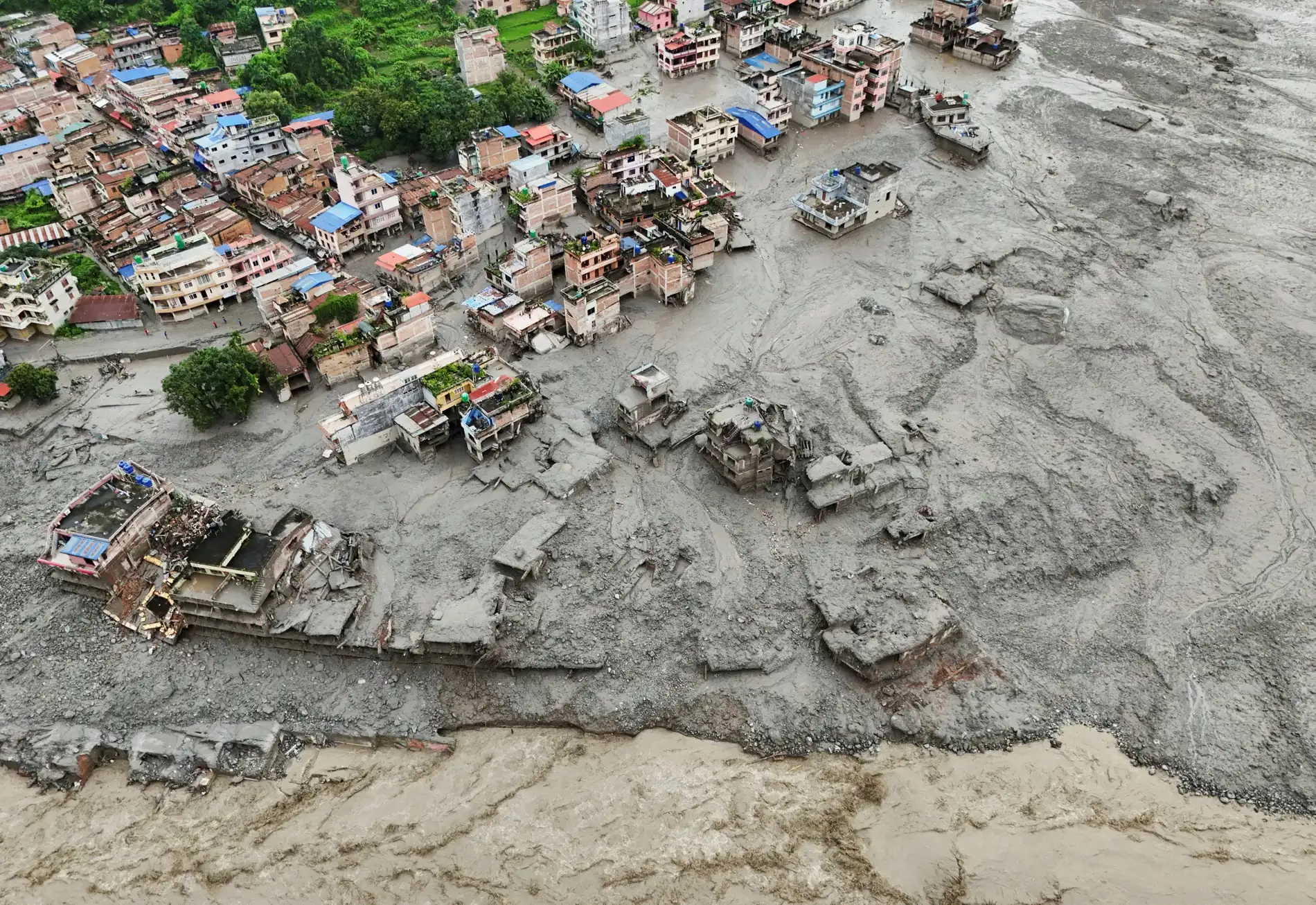
The catastrophic Himalayan Flood that struck Nepal's Rasuwa district and Tibet on August 26, 2026, was not simply a story about water rushing down a mountain valley. It exposed a harder question. When scientists have spent years documenting growing glacier and flood risks, how much of the eventual destruction can be blamed on failures in monitoring, communication and preparedness? The latest evidence points to a complicated answer.
Scientists had warned for years that a warming Hindu Kush Himalaya was creating more unstable glaciers, expanding glacial lakes and increasing the potential for sudden floods. ICIMOD reported in March 2026 that Himalayan glaciers were losing ice at roughly twice the rate recorded since 2000, while warning that large parts of the region remain poorly monitored.
But that does not mean scientists predicted the exact August 26 flood.
The immediate event appears to have involved a sudden ice and rock collapse that struck with the seismic force of a magnitude 5.2 earthquake, according to the US Geological Survey, followed by a debris surge into the Bhotekoshi River. Nepal's disaster authorities and hydrologists are still investigating the precise chain of events.
The sharper issue is whether authorities had enough systems in place to detect such a rapidly developing hazard and warn people downstream.
The Warning Was There, But Not Necessarily for This Flood
The scientific warning about Himalayan hazards is not new.
For years, researchers have documented the growth of glacial lakes and the danger of glacial lake outburst floods across the region. ICIMOD's inventory covering Nepal, Tibet and India has repeatedly identified potentially dangerous glacial lakes and emphasized the need for stronger monitoring and early warning systems.
In 2025, the danger became painfully concrete in this same border region.
A sudden flood originating in Tibet crossed into Nepal's Rasuwa district in July 2025, damaging the Nepal-China Friendship Bridge, hydropower facilities and the Rasuwagadhi trade corridor, and killing at least eight people. Nepal's Department of Hydrology and Meteorology later linked that event to the rapid drainage of a supraglacial lake roughly 36 kilometers north of the border.
That previous disaster should have been a major warning for policymakers.
Instead, the region entered another flood season with fundamental weaknesses still visible in cross-border hazard monitoring.
The 2025 Disaster Had Already Exposed the Gap
After the 2025 flood, Nepal and China discussed stronger coordination and disaster information sharing. Yet more than a year later, officials on the Nepali side again described receiving word of the danger only after floodwaters had already begun crossing the border.
That history makes the 2026 disaster particularly significant.
A Flood in Nepal and China is not necessarily a problem either country can manage independently. Rivers cross the border, and the hazards that generate sudden surges can originate far upstream in territory neither country actively watches for this specific kind of risk.
If the danger begins in Tibet, waiting until the water reaches Nepal leaves communities with very little time.
The 2026 Flood Exposed a Dangerous Communication Gap
Rasuwa's chief district officer, Narendra Pariyar, said the flood struck around 9:15 a.m. local time with almost no warning, giving residents in riverside settlements very little time to react. Reports indicate Tibetan authorities alerted Nepal's local police administration only after the surge had already been observed moving downstream.
The problem was that by the time word reached local officials, the flood had already entered Nepal.
That difference may appear small on paper. In a steep Himalayan valley, it can determine whether people have time to escape or are caught in the flood's path.
Nepal's warning infrastructure also faced another problem. Automated monitoring stations along the affected river system were reportedly among the structures swept away, cutting off a source of real-time data before it could generate a useful alert.
The result was a chain of failures:
- The hazard developed upstream of Nepal, in territory not actively flagged as a watch zone.
- No timely cross-border warning reached Nepal before the surge crossed into its territory.
- The flood traveled extremely quickly once it entered the country.
- Monitoring equipment along the river was damaged or destroyed.
- Official alerts reached some downstream communities only after the event had begun.
- This is where the question of administrative failure becomes difficult to dismiss.
A Flash Flood Is Not the Same as a Forecastable Storm
There is an important distinction that should not be lost in the investigation.
A Flash flood Nepal and China event caused by an ice or rock collapse can develop far more quickly than a conventional rainfall flood.
Scientists cannot always predict the exact moment when a glacier will collapse, a debris dam will form or an impounded river will suddenly burst.
The current evidence does not establish that authorities knew a catastrophic flood would strike Rasuwa at a specific time. Some unverified claims have circulated suggesting Chinese authorities issued an earlier warning weeks before the disaster, but Nepali hydrologists cited in local reporting said there was no confirmed evidence supporting that claim.
That distinction is crucial for a fact-checking investigation.
Scientists warned about the hazard. That is different from predicting this particular event.
The Bigger Failure Was Preparedness
The more defensible criticism concerns preparedness, not prediction.
The region had already experienced a deadly transboundary flood in 2025. Scientists had identified growing glacier-related risks. ICIMOD had repeatedly called for stronger multi-hazard monitoring and early warning systems across the Hindu Kush Himalaya.
Yet the 2026 event again exposed weaknesses in the system.
A bilateral agreement or cooperation framework is only useful if information can move rapidly from the source of a hazard to the communities at risk. Nepal's opposition leader and former prime minister, Pushpa Kamal Dahal, publicly called for the immediate activation of early warning systems in coordination with neighboring countries, a statement that implies those systems were not fully operational when the flood struck.
The Border Became the Blind Spot
The Nepal flood China border problem is fundamentally geographical.
Nepal sits downstream from large areas of the Tibetan Plateau. A dangerous event can therefore begin outside Nepal's territory while the consequences arrive inside it within minutes.
A domestic warning system cannot fully solve a transboundary problem. What is needed is a connected system involving:
- Real-time river and glacier monitoring on both sides of the border.
- Satellite-based hazard detection covering unmonitored tributaries.
- Shared data feeds between Nepali and Chinese disaster agencies.
- Automatic cross-border alerts rather than manual notifications.
- Emergency communication systems reaching local governments directly.
- Evacuation plans specific to exposed riverside settlements.
- Regular community-level disaster drills in high-risk valleys.
Analysts writing in New Spotlight Magazine described the disaster as exposing a structural gap, arguing that no formal transboundary disaster risk management framework currently exists between Nepal and China covering the full cycle of risk assessment, monitoring and early warning.
Climate Change Raised the Stakes, But It Was Not the Sole Explanation
The climate connection also needs careful handling.
ICIMOD says glaciers across the Hindu Kush Himalaya are losing ice at an accelerating rate. Researchers have warned that shrinking glaciers and changing conditions in the region's ice fields can intensify hazards such as glacial lake outburst floods and sudden avalanches.
But scientists have not yet established that climate change directly caused this specific August 2026 flood.
Initial assessments describe a suspected ice and rock avalanche, while noting that the precise role of long-term warming in this individual event remains unconfirmed.
That is the evidence-based position. Climate change is increasing the background risk. It does not automatically prove that every individual Himalayan disaster was caused by climate change.
Conclusion:
The evidence does not support the simplistic claim that scientists predicted the August 2026 Himalayan Flood and governments ignored a precise warning.
It does support something more serious.
Scientists had warned about accelerating glacier change, expanding glacial lakes and the need for stronger early warning systems. A similar transboundary flood had already struck the Nepal-China region in 2025. Authorities had discussed improving information sharing, yet the 2026 surge again reached Nepal before an effective cross-border warning could be delivered.
So, did administrative failures turn a Himalayan hazard into a disaster?
They did not create the flood, but weaknesses in monitoring, communication and preparedness may have amplified its human cost.
That is the central finding that deserves further scrutiny.
The next test is not another rescue operation after the water arrives. It is whether Nepal and China build a real-time system capable of detecting the next glacier collapse, river blockage or sudden outburst before it reaches the people living downstream.
In the Himalayas, the difference between knowing a hazard exists and knowing it is happening may be measured in minutes.



Comments (0)
Leave a Comment
No comments yet
Be the first to comment