
Four astronauts are now circling the Moon aboard Orion. Beyond the spectacle, this 10-day mission is the most consequential systems test in a generation of spaceflight.
10 Mission Days
252,760 mi. Max Distance from Earth
Apr 10. Splashdown Date
Why Artemis II Is Not Just Another Launch
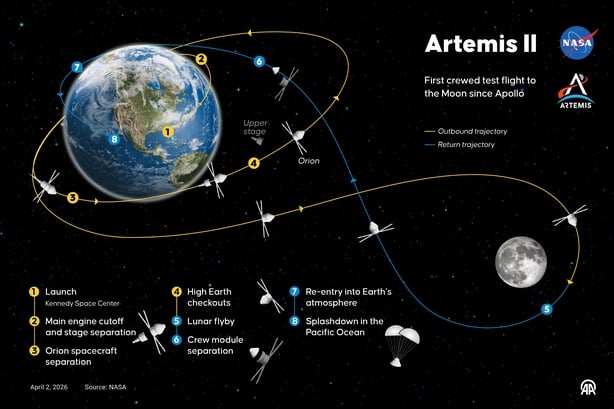
When NASA's Space Launch System rocket lifted off from Kennedy Space Center's Launch Complex 39B on April 1, 2026, at 6:35 p.m. EDT, it did more than carry four astronauts into orbit. It restarted a chapter of human history that had been closed since December 1972, when the last Apollo 17 astronauts left the lunar surface. Artemis II is the first crewed mission to travel beyond low Earth orbit in over 50 years.
The mission is a systems validation flight, not a landing. Commander Reid Wiseman, pilot Victor Glover, mission specialists Christina Koch and CSA astronaut Jeremy Hansen are aboard Orion, named "Integrity," on a carefully planned 695,081-mile round trip around the Moon and back to Earth. The analytical significance here is critical: this is not a symbolic gesture. It is a structured engineering trial under real deep-space conditions that cannot be replicated in any simulation on Earth.
The Four Astronauts and Why This Crew Is Historic
Reid Wiseman (Commander, NASA)
Victor Glover (Pilot, NASA)
Christina Koch (Mission Specialist, NASA)
Jeremy Hansen (Mission Specialist, CSA)
Victor Glover is the first Black astronaut to fly on a deep space mission. Christina Koch is the first woman to travel to lunar distance. Jeremy Hansen is the first Canadian to fly beyond Earth orbit. These are not ceremonial distinctions. They reflect a deliberate shift in who participates in exploration, shaping public trust and international investment in the broader Artemis program.
What the Mission Is Actually Testing
Artemis II is designed to evaluate Orion's life support systems, communication links, manual piloting capability, and navigation precision under actual deep-space radiation and thermal conditions. On Flight Day 4, Koch manually piloted Orion, testing the spacecraft's response controls. On April 6, the crew performed their closest approach to the Moon at approximately 4,600 miles above the lunar surface, simultaneously breaking the distance record set by Apollo 13 in 1970 by over 3,366 miles.
"All of our communication depends on having a line of sight with Earth. It is nerve-racking, because whenever you do not have communication with the spacecraft, you do not have insight as to what is going on." - Rick Henfling, Lead Artemis II Entry Flight Director, NASA
The 40-minute communication blackout during the lunar far-side flyby was one of the most scrutinized segments. Mission Control had to brief the crew in advance and trust onboard systems to hold course independently. This kind of autonomous operation is foundational for future missions to the lunar surface and, eventually, Mars.
The Broader Strategic Picture
Artemis II does not exist in isolation. It sits inside a competitive geopolitical context where China's crewed lunar program is making steady progress. The U.S. lead in the lunar race, while still present, has narrowed due to years of Artemis delays rooted in heat shield concerns, hydrogen leaks, and supply chain pressures. If Artemis II succeeds, it clears the path for Artemis III, which will aim to land astronauts near the Moon's south pole in 2028, targeting water-ice deposits that could enable long-duration habitation.
The European Space Agency's service module powering Orion is also a significant data point. Artemis is no longer a unilateral U.S. program. It is a multilateral architecture where ESA, CSA, and JAXA contributions are structurally embedded. This internationalization both strengthens the program's resilience and raises its geopolitical stakes.
What Comes Next
The Orion spacecraft is scheduled to splash down off the coast of San Diego on April 10, 2026, at approximately 8:07 p.m. EDT. Recovery teams will retrieve the crew by helicopter and deliver them to the USS John P. Murtha. Post-mission data from Orion's systems will directly inform the design decisions for Artemis III's upgraded heat shield and lunar landing protocols.
Artemis II is proof of concept at full scale. Its success or failure will determine the tempo of the entire Moon-to-Mars strategy for the next decade.




Comments (0)
Leave a Comment
No comments yet
Be the first to comment