"Southern states stand to be penalised for their own success. A democracy that punishes development is a democracy with a design flaw." Editorial Board, Bright Mirror News
The Freeze Is Over. The Reckoning Has Begun.
On April 1, 2026, India's census process formally began, setting in motion the constitutional clock that will end a 50-year freeze on parliamentary seat redistribution. What happens next will determine whether India's federal democracy emerges stronger or fractures along a fault line that has been quietly deepening for decades.
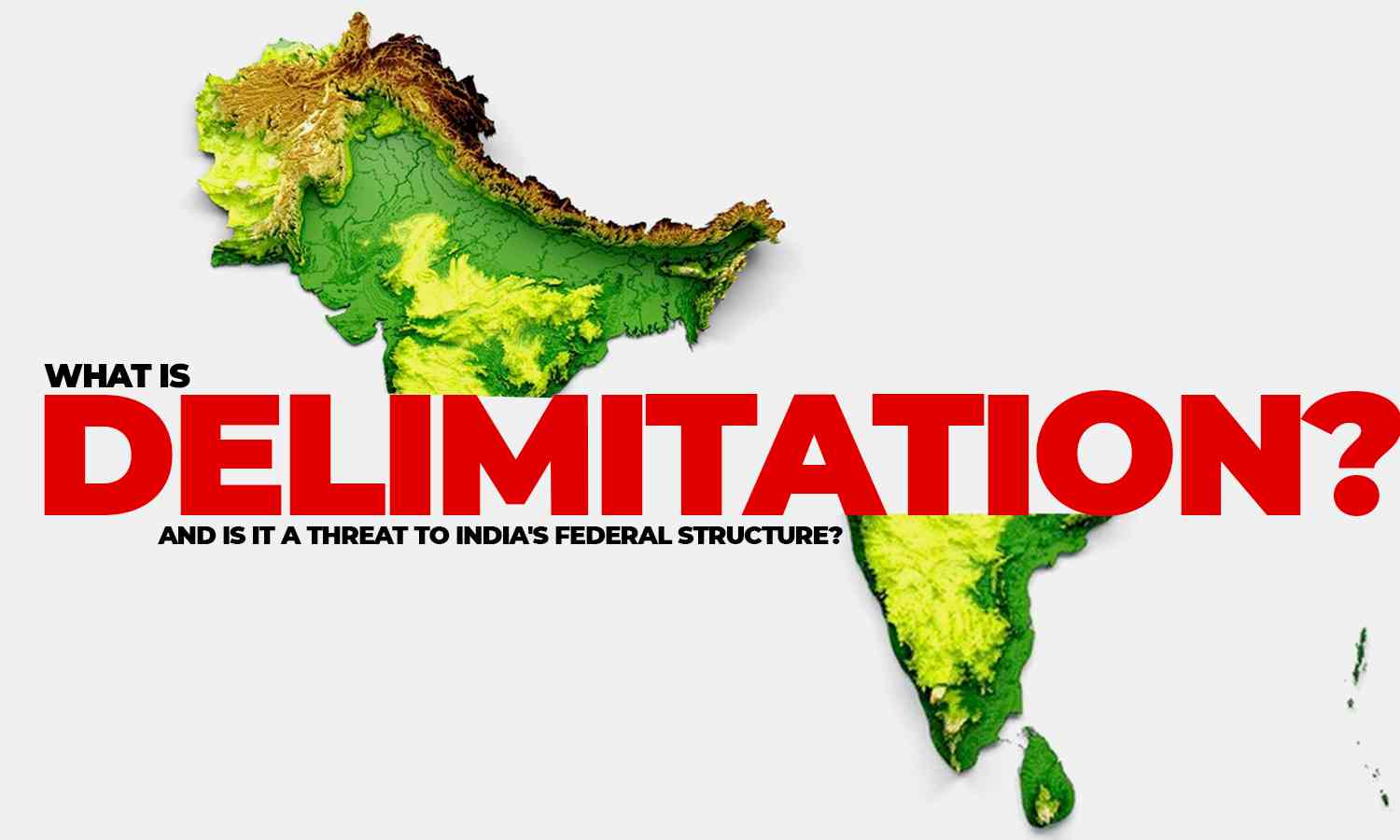
India's delimitation debate 2026 is not simply about redrawing electoral maps. It is about a foundational question: what should representation mean in a country where different states have made fundamentally different choices about how to govern themselves, educate their people, and manage their own populations?
That question deserves an honest answer, not platitudes.
"A Damocles Sword": What the Numbers Actually Say

Northern States Gain 43 Seats. Southern States Lose 24. That Is Not Democracy. That Is Arithmetic Dressed Up as Democracy.
If the current 543-seat Lok Sabha were reapportioned strictly by population using the most recent census data, northern states would gain an estimated 43 parliamentary seats while southern states would lose 24. Uttar Pradesh alone would surge from 80 to 120 seats. Kerala could see its representation fall.
The most dramatic proportional changes would be in Kerala, projected at a 30% reduction in its Lok Sabha share, and Tamil Nadu at 23%. Bihar and UP together would gain more seats than the combined loss of Andhra Pradesh, Karnataka, and Kerala.
Even the "compromise" proposal of expanding the Lok Sabha to 816 seats, an increase from 543 using 2011 census data, does not neutralise the power shift. It mathematically dilutes it while leaving the structural imbalance fundamentally intact. An expanded house where UP grows from 80 to 120 seats and Kerala barely holds at 20 is not equity. It is a slower version of the same injustice.
The South's representation in the Lok Sabha is projected to drop from 24% to 19% in various scenarios. That shift, as analysts at The Squirrels have noted, could allow a central government to be formed entirely by winning seats in the North, effectively making the South politically invisible despite its massive economic contributions.
That outcome is a democratic design failure.
The Perversity at the Centre of the Debate
"A School Where the Obedient Student Loses Privileges for Following the Rules"
Tamil Nadu's Total Fertility Rate is approximately 1.4. Kerala's is approximately 1.8. Both states reached replacement-level fertility decades ago, having genuinely internalised the national policy on family planning that the central government advocated for generations.
Bihar's TFR remains approximately 3.0. Uttar Pradesh's fertility decline has been slower. This is not a moral judgment about those states. It is a demographic reality that reflects different histories of education, women's empowerment, and public health investment.
Now, under a population-only delimitation formula, the states that listened, invested, and succeeded are penalised. The states that grew faster are rewarded with more seats.
As Telangana Chief Minister A. Revanth Reddy warned in the Telangana Assembly in March 2025: the South would be "at the receiving end" for successfully implementing family planning. Tamil Nadu Chief Minister M.K. Stalin convened a Joint Action Committee on Fair Delimitation in Chennai, where chief ministers of multiple southern states demanded that the seat freeze be extended for another 25 years.
These are not voices of regional grievance for its own sake. They are voices pointing out a genuine logical contradiction at the heart of the delimitation process.
The Finance Commission Already Understood This. Why Can't the Delimitation Commission?
"Demographic Performance" Carries 18% Weight in Tax Devolution. It Should Carry Weight in Seat Allocation Too.
The Finance Commission, which determines how central tax revenues are devolved to states, already uses a "demographic performance" indicator that carries 18% weight in its allocation formula. States that successfully controlled population growth are rewarded in the fiscal transfer calculation.
That logic is sound. It acknowledges that demographic outcomes are policy outcomes, not accidents. It recognises that a state which invested in literacy, maternal health, and women's education to bring its TFR below 2.0 made choices that had costs, and those choices deserve acknowledgment.
The proposed Demographic Performance (DemPer) principle, advocated by several policy researchers, extends exactly this logic to seat allocation. It would blend population, Total Fertility Rate, and Human Development Index into a weighted formula. A state's parliamentary representation would be determined not purely by how many people it has, but by how it has managed its demographic trajectory relative to national goals.
This is not a radical idea. It is the same idea the Finance Commission already applies to money. We are simply asking whether it can apply it to votes.
Germany's Bundesrat weights state representation to prevent the complete domination of larger states. The European Parliament uses degressive proportionality so smaller member states retain a meaningful voice. India's own Rajya Sabha was designed with equal state representation precisely because the founders understood that pure population arithmetic could silence smaller or more developed states.
The intellectual architecture for a balanced solution exists. What is missing is the political will to use it.
The Three Paths Forward: And Why Only One Is Defensible
"Whatever Decision the Government Takes, It Is Likely to Be Acrimonious"
Three broad options are on the table. This editorial argues that only the third has any claim to fairness.
Option One: Pure Population Redistribution. Reallocate Lok Sabha seats strictly based on current population. This is constitutionally straightforward and democratically principled in the narrowest sense. It is also politically catastrophic and morally indefensible if applied without adjustment. It penalises demographic success, deepens the North-South divide, and sends every Indian state the message that investing in development and family planning is electorally irrational.
Option Two: Expanding the Lok Sabha Without a New Formula. Increase seats to 816 or higher so no state formally loses seats in absolute terms while northern states gain proportionally. This is the "mathematical illusion" that several analysts have identified. It preserves the formal appearance of fairness while executing the same power shift over a longer timeline. A Lok Sabha of 800-plus members also raises serious questions about parliamentary efficacy and the quality of legislative deliberation.
Option Three: A Weighted Representation Formula Combined With Selective Expansion. Use 2011 census data as the base, expand the Lok Sabha to accommodate Women's Reservation, and incorporate a weighted allocation formula that factors in TFR and HDI alongside population. This approach rewards governance achievement while acknowledging the democratic principle of proportional representation. It acknowledges that 50 years of divergent demographic choices cannot be corrected overnight without injustice, but that the correction should be calibrated rather than blunt.
The government's current position, assurances that "no southern state will lose seats" paired with no disclosed formula, is not a policy. It is a deferral. Deferral is how a constitutional process scheduled for formal action gets converted into a political crisis.
What the Election Commission and Parliament Must Do Now
Consultation First. Commission Later. Not the Other Way Around.
A Delimitation Commission is expected to be established by June 2026 to redraw boundaries before the 2029 general elections. The commission, by design, is quasi-judicial and largely insulated from political negotiation. That makes the debate that precedes its constitution the most important moment.
Parliament must act before the commission is formed. Specifically:
A constitutional amendment must clarify that the delimitation formula will incorporate weighted demographic performance criteria, not purely population counts. The Rajya Sabha's structure must be reformed to make it a genuine forum for federal deliberation rather than a parking ground for party loyalists, as analysts at NUS ISAS have argued.
The census process, now formally launched as of April 1, 2026, must be completed with independence and transparency. Southern states' concerns about delayed or politically managed census data are legitimate and deserve structural safeguards.
A national consultative forum, bringing together chief ministers, the Finance Commission, the Election Commission, and constitutional experts, must develop the weighted formula in the open, not behind closed legislative doors.
The BJP has long sought to deepen its presence in South India. As analysts have noted, an approach that is unmindful of Southern concerns would threaten this aspiration. Even RSS-linked commentators have cautioned against proceeding without sensitivity to southern concerns. The political incentive structure, for once, aligns with the right policy choice.
A Democracy That Punishes Success Is a Democracy in Decline
The Delimitation Debate Is a Test of Whether India's Federalism Is Real or Ceremonial
The 1976 freeze, imposed by Indira Gandhi during the Emergency and extended by Parliament in 2002, was a pragmatic acknowledgment of a real risk: that population-based redistribution would punish states for implementing national policy on family planning. It was an imperfect solution but a honest one. It acknowledged a contradiction in the constitutional design and deferred its resolution.
That deferral has now expired. The census has begun. The clock is running.
India has until the 2029 elections to demonstrate that its federal democracy can adapt to the consequences of its own policy successes. If the delimitation exercise proceeds on pure population arithmetic, India will have made a decision whose consequences will unfold across decades: that the most governable, most developed, most demographically stable states have the least political voice.
That is not a version of Indian democracy worth defending.
A fair delimitation formula exists. The intellectual tools are available. The Finance Commission has already shown the way. What remains is the political courage to apply those tools before the Delimitation Commission begins its work.
The southern states have earned their political representation through generations of investment in human development. The delimitation debate of 2026 is the moment to decide whether that investment will be honoured or penalised.
This editorial stands clearly on the side of a balanced federal reform: one that expands the Lok Sabha, incorporates demographic performance alongside population, and preserves India's federal compact for the generations that are watching how their democracy navigates its hardest choices.



Comments (0)
Leave a Comment
No comments yet
Be the first to comment