The United States has ended one of the longest standing policies in its student visa system. The Department of Homeland Security (DHS) has finalized a rule that replaces open ended "duration of status" admission with a fixed four year limit for most F and J visa holders, closing a framework that had been in place since 1978.
What the New DHS Rule Changes
Under the previous system, international students could remain in the country for as long as they stayed enrolled and made progress toward their degree, regardless of how many years that took. The new rule sets a hard ceiling.
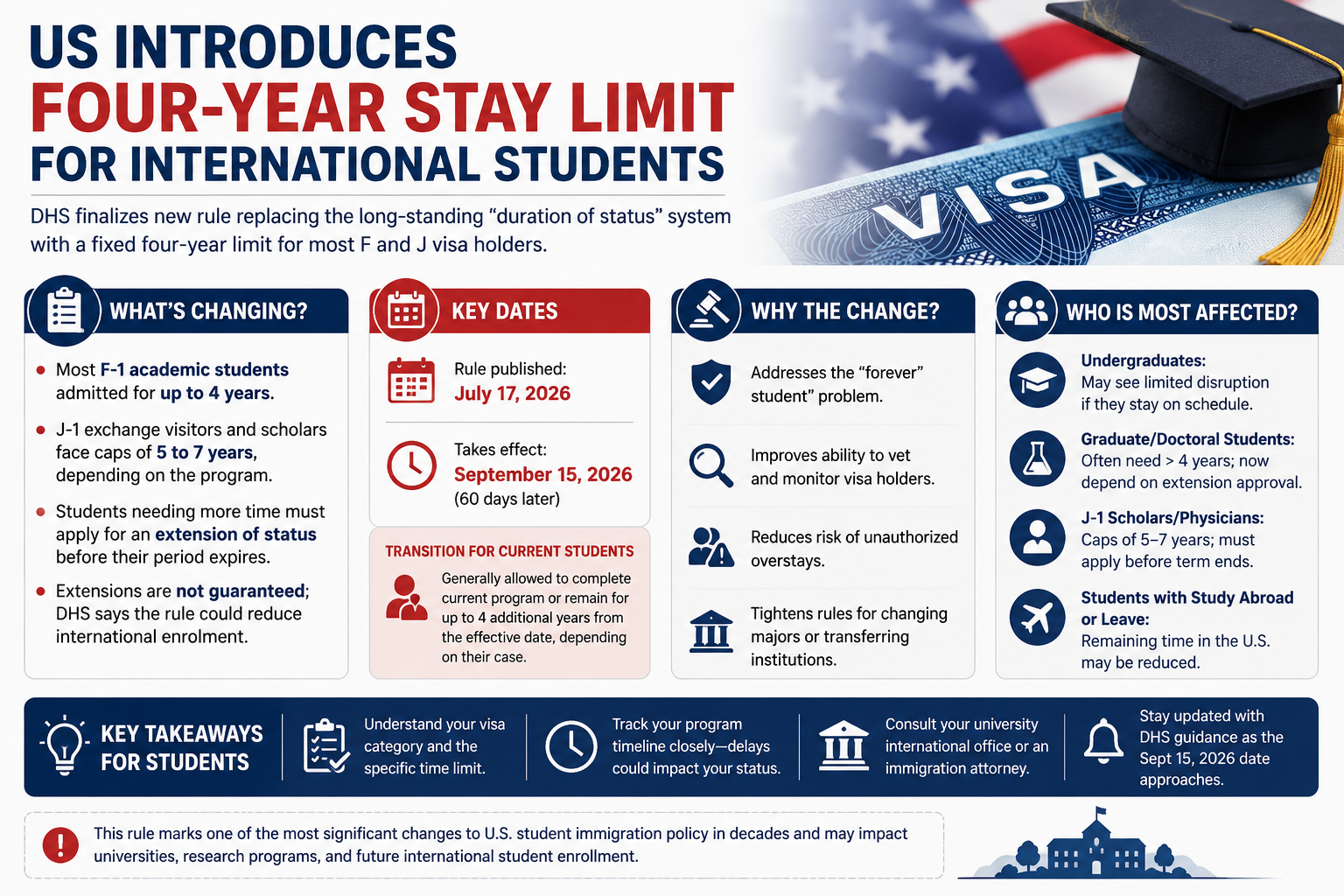
- Most F-1 academic students will now be admitted for a fixed period of up to four years
- J-1 exchange visitors and scholars face similar caps, with some programs allowed up to five or seven years before needing an extension.
- Students who need more time must file for an extension of status before their authorized period expires.
- Extensions are not guaranteed, and DHS has acknowledged the rule could reduce international enrolment.
When the Rule Takes Effect
The rule was published on July 17, 2026, and is scheduled to take effect 60 days later, on September 15, 2026. Students already in the country under the old duration of status framework will generally be allowed to complete their current program period, or remain for up to four additional years from the effective date, whichever transition provision applies to their case.
Why the Policy Is Changing
DHS has framed the shift as a response to what officials call the "forever student" problem, where individuals extended their time in the country by repeatedly changing academic programs or institutions without a clear endpoint. The agency argues that fixed terms improve its ability to vet and monitor visa holders and reduce the risk of unauthorized overstays.
Restrictions Beyond the Time Limit
The rule does more than cap duration. It also tightens the process for switching majors or transferring between institutions once a student has arrived, a change that education groups say could complicate legitimate academic transitions such as moving from an undergraduate program into a master's or doctoral track.
Impact on Students, Universities and Research
Colleges and universities have already raised concerns that the policy could discourage prospective international applicants and disrupt students currently mid program, particularly those in longer doctoral tracks or dual degree pathways that routinely exceed four years.
Who Is Most Affected
The change carries different weight depending on the type of program and visa category.
- Undergraduate students pursuing a standard four year degree may see limited disruption if they stay on schedule.
- Graduate and doctoral students in research heavy fields often need more than four years and will now depend on discretionary extension approval.
- J-1 research scholars and physicians face longer caps of five to seven years but still must apply before their term lapses.
- Students who study abroad or take a leave during their program may find their remaining time in the US further reduced.
University Response and Planning
International offices at universities are expected to begin advising current and incoming students on how the transition rules apply to their specific visa category. Institutions with large international enrollments, particularly in STEM and health sciences, are likely to face the greatest administrative burden as they help students track fixed admission periods that did not exist under the old system.
What Comes Next for International Education Policy
The rule marks one of the most consequential changes to US student immigration policy in decades, and it arrives alongside other recent tightening measures, including new requirements for some visa holders to apply for permanent residency from outside the country rather than adjusting status while in the US.
Key Takeaways for Prospective and Current Students
- Confirm which visa category applies and what the specific duration cap is for that program.
- Track program timelines closely, since delays in coursework, research or clinical training could now carry immigration consequences.
- Consult a university international student office or immigration attorney before making decisions about changing majors, institutions or taking academic leave.
- Watch for further guidance from DHS as the September 15, 2026 effective date approaches.
Whether the rule reduces enrollment as DHS itself has predicted will likely become clear over the next several admission cycles, as universities and prospective students weigh the added uncertainty against the value of studying in the United States.



Comments (0)
Leave a Comment
No comments yet
Be the first to comment