When Hrishikesha Narsha, a group manager in software development at Oracle's Bengaluru office, logged into his LinkedIn account the morning after Oracle's latest layoff wave, he did not post in anger. He posted in reflection. Sixteen years. Thousands of working hours. Countless product cycles. And then, an email at 6 am telling him it was over.
His post, which read "thinking about family, finances, and the future," became one of the most widely shared responses to Oracle's most recent round of job cuts, which reportedly impacted around 30,000 employees globally. The numbers are staggering. But Narsha's post reminds us that behind every headcount reduction is a human recalibration.
What Actually Happened at Oracle
Oracle's layoffs were announced through an early morning email that cited a broader reorganisation aimed at accelerating investment in cloud infrastructure and artificial intelligence. For most employees, there was no prior signal, no transition period, and no gradual wind-down. Narsha described waking up to find that "daily priorities have shifted overnight," a phrase that captures the disorientation that thousands of tech workers across the world are experiencing right now.
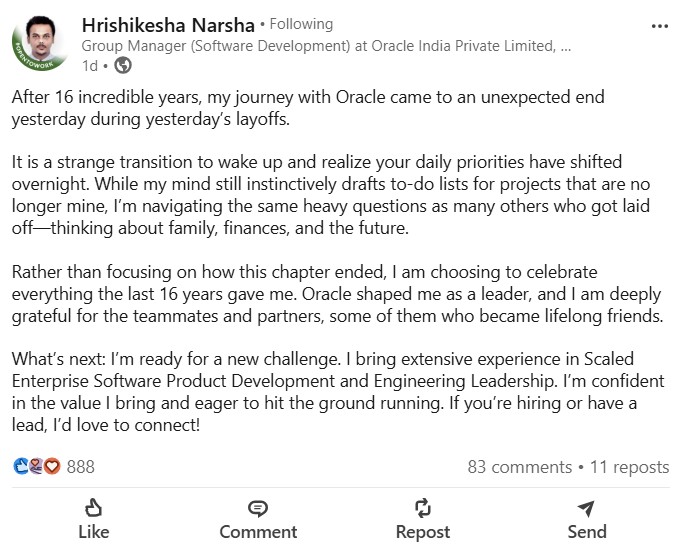
The timing was particularly striking because it coincided with the viral circulation of a video featuring Oracle co-founder Larry Ellison stating that Oracle no longer writes much of its own code. According to Ellison, AI models now generate software based on human intent. That statement, placed alongside the scale of the layoffs, made the subtext explicit: Oracle is restructuring its workforce around artificial intelligence, and experienced human engineers are being repositioned out of the picture.
The Analytical Reality: AI Restructuring Is Not a Future Event
For years, the conversation around AI and jobs was largely speculative. Analysts debated timelines, economists argued about net job creation, and technology companies insisted that AI would augment workers rather than replace them. What Oracle's layoff wave demonstrates is that the transition has already begun, and it is happening faster than most workforce planning models anticipated.
Oracle is not an outlier. Across the global technology sector, companies including Meta, Google, Microsoft, Salesforce, and SAP have all executed significant headcount reductions over the past 18 months, with many citing AI-driven efficiency gains as the justification. The pattern is consistent: organisations are investing heavily in AI infrastructure while simultaneously reducing their human software development workforce.
For India, this trend carries particular weight. Bengaluru is the epicentre of India's technology employment ecosystem. Oracle, along with dozens of other multinational technology firms, employs tens of thousands of engineers, managers, and product professionals across the city. When layoffs at this scale occur, the ripple effects extend beyond individual careers. Housing markets, consumer spending, and the broader service economy in Bengaluru all feel the pressure.
Why Narsha's Response Matters Beyond the Personal
What sets Narsha's post apart from the typical layoff announcement is its tone. He chose, as he explicitly stated, to reflect on what Oracle gave him rather than dwell on how he was let go. He called Oracle a place that "shaped him as a leader" and acknowledged friendships that outlasted professional titles.
That measured response deserves analytical attention because it reflects something important about how senior technology professionals are processing this moment. There is no widespread public anger directed at Oracle, despite the scale of the cuts and the manner in which they were communicated. The dominant emotion, at least among those speaking publicly, appears to be a kind of resignation mixed with resilience. Narsha wrote, "What's next is another chapter," and his post drew an outpouring of support from peers who had experienced similar exits.
This is not passivity. It is pragmatism. People who have spent careers in enterprise technology understand that the sector is structurally shifting. The question they are asking is not whether AI will change employment patterns in software development. That question has been answered. The question now is how individuals, companies, and governments should respond.
What Comes Next for Displaced Tech Professionals
Narsha highlighted his background in scaled enterprise software product development and engineering leadership while actively reaching out to recruiters. This is the correct instinct. Senior technology managers with deep domain knowledge and cross-functional leadership experience are not being made redundant by AI. They are, however, being asked to reframe their value proposition around AI-assisted delivery rather than traditional code ownership.
The professionals who will navigate this transition successfully are those who understand what AI can and cannot do at an enterprise scale, and who can lead organisations through the ambiguity that comes with deploying it responsibly.
The Larger Question
Oracle's restructuring is a case study in a tension that every major technology company will face over the next five years. Productivity gains from AI are real. The human cost of achieving those gains at speed is also real. Hrishikesha Narsha's story does not resolve that tension. But it names it honestly, and that matters.



Comments (0)
Leave a Comment
No comments yet
Be the first to comment