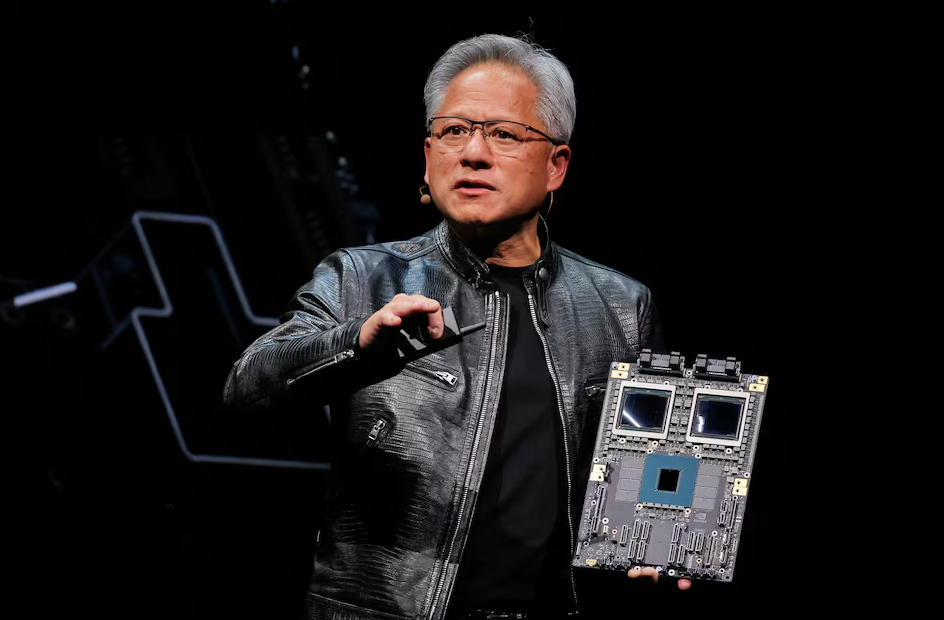
Nvidia CEO Jensen Huang has spent 2026 pushing his company beyond its traditional stronghold in data center chips and into nearly every layer of the artificial intelligence stack, from personal computers to humanoid robots to autonomous vehicles. His strategy reflects a broader bet that AI will not remain confined to cloud servers but will spread into consumer devices, factories, and physical machines that reason and act in the real world.
Huang's public appearances this year, from the Consumer Electronics Show in Las Vegas to Computex in Taipei to a high profile Senate hearing in Washington, illustrate how central Nvidia has become to both the technology industry and the political debate over AI's global supply chain.
Nvidia's Expansion Beyond the Data Center
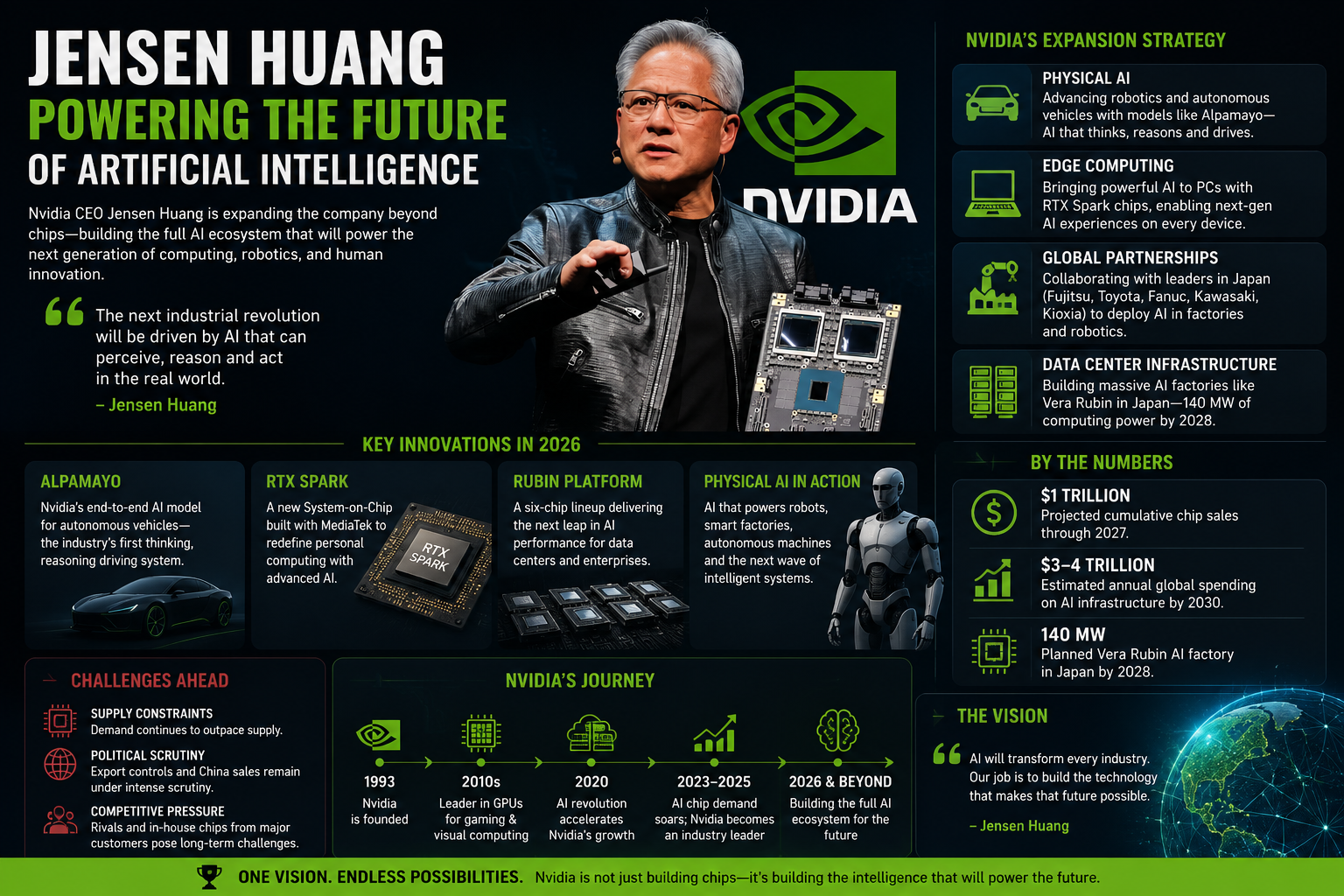
At CES 2026, Huang unveiled Alpamayo, an AI model built for autonomous vehicles, describing it as the industry's first thinking, reasoning driving system trained end to end from camera input to vehicle control. He paired the announcement with the Rubin platform, a six chip lineup set to reach Nvidia's partners in the second half of the year, and predicted that self driving vehicles would become one of the largest robotics industries going forward.
By June, Huang had shifted focus toward personal computing. At Computex in Taipei, he introduced RTX Spark, a system on chip built with Taiwan's MediaTek, framing the move alongside Microsoft as an effort to reinvent the PC. The announcement signaled Nvidia's intent to bring advanced AI processing to laptops and desktops rather than relying solely on cloud based computing, a shift that immediately pressured shares of rival chipmakers.
Where Nvidia Is Placing Its Bets
- Physical AI, including robotics and autonomous vehicles trained through models like Alpamayo.
- Edge computing, bringing AI capability directly into personal computers through chips like RTX Spark.
- Global manufacturing partnerships, such as Nvidia's collaboration with Fujitsu, Toyota, Fanuc, Kawasaki Heavy Industries, and Kioxia in Japan to deploy AI across factories and robotics.
- Data center infrastructure, still the core of Nvidia's business, including a planned Vera Rubin AI factory in Japan targeting 140 megawatts of computing power by 2028.
Huang has framed these moves as part of a single connected vision, arguing that the technology underpinning cloud data centers, PCs, and robots is fundamentally the same, only scaled differently for each environment.
Nvidia's manufacturing partnerships in Japan reinforce this connected approach. Following a visit to Tokyo, Huang announced collaborations with Fujitsu, Toyota, Fanuc, Kawasaki Heavy Industries, and Kioxia to deploy what the company calls physical AI across robots and factory systems. He said Japan's manufacturing base made it a natural testing ground for this technology, pairing local expertise in mechatronics with Nvidia's AI computing platforms. The planned Vera Rubin AI factory, targeting 140 megawatts of computing power by 2028, is designed to support this expanding footprint in industrial robotics and automated manufacturing.
Huang has also acknowledged that demand for Nvidia's chips continues to outpace what the company can currently supply, even as it works to expand capacity. That tension between surging demand and constrained supply has become a recurring theme in his public remarks throughout the year, shaping how investors and partners interpret Nvidia's growth trajectory.
Financial Outlook, Supply Constraints, and Political Scrutiny
Huang has repeatedly reassured investors that AI chip demand remains far from peaking. At Nvidia's GTC conference in March, he projected the company would collect one trillion dollars in cumulative chip sales through 2027, doubling an earlier five hundred billion dollar forecast. Nvidia's chief financial officer has separately estimated that annual spending on AI infrastructure could reach three to four trillion dollars by the end of the decade.
Despite that bullish outlook, Nvidia has faced a volatile year in the markets. The company briefly held a market capitalization above five trillion dollars before slipping behind Apple as the world's most valuable company, with shares posting only modest gains in 2026 compared to the prior year's rally. Huang has urged investors to treat market weakness as a buying opportunity, telling audiences in Seoul that sell offs in chip stocks represent moments to act rather than retreat.
Key Financial and Policy Signals to Watch
- Nvidia's stated one trillion dollar chip sales target through 2027.
- Ongoing supply constraints, with Huang confirming the company remains supply limited even while securing capacity for what he calls robust growth.
- Political scrutiny over China sales, highlighted by a Senate Banking Committee hearing where lawmakers pressed Huang on export controls following his visit to Beijing alongside President Trump for talks with President Xi Jinping.
- Competitive pressure from rivals including Broadcom and Advanced Micro Devices, along with the risk that major customers increasingly design their own in house AI chips.
The China related scrutiny is particularly significant given Nvidia's chips form the backbone of most global AI data centers, making the company a focal point in broader debates over technology export policy and national security.
Nvidia's stock trajectory over the past several years underscores how quickly its fortunes have shifted with the broader AI narrative. Shares climbed more than 1,100 percent over the previous three years as the company established itself as the dominant supplier of AI training chips, closing out 2025 with a market capitalization above 4.5 trillion dollars. That momentum has cooled somewhat in 2026, with shares posting comparatively modest gains even as Huang continues to project long term confidence in AI infrastructure spending.
Competitive dynamics add further complexity to Nvidia's position. Rivals including Broadcom and Advanced Micro Devices are working to capture a larger share of the AI chip market, while some of Nvidia's largest customers, including major cloud providers, are investing in their own in house chip designs. Huang has consistently downplayed these threats publicly, though analysts continue to weigh how much they could erode Nvidia's pricing power and market share over the coming years.




Comments (0)
Leave a Comment
No comments yet
Be the first to comment