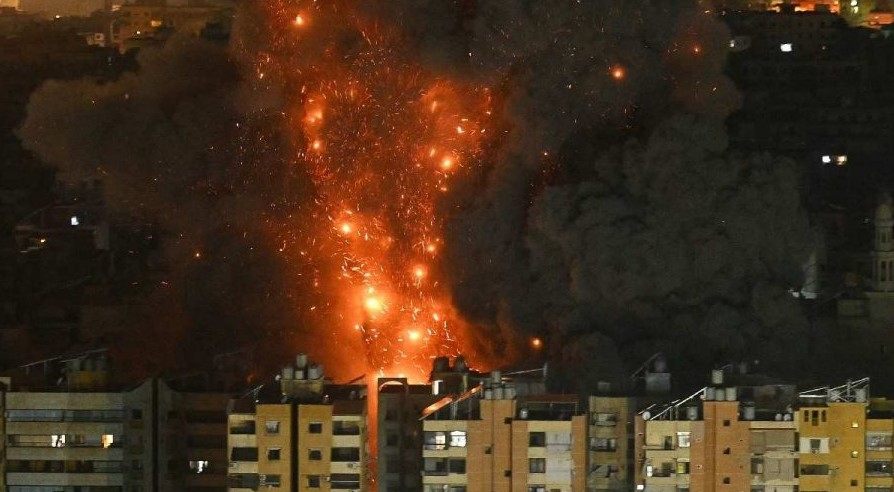
Massive US–Israel Airstrikes Ignite the Middle East’s Most Dangerous Conflict in a Generation
Operation Epic Fury begins with nearly 900 strikes in twelve hours, killing Iran’s supreme leader and triggering a regional missile war
AT A GLANCE
Operation Name | Operation Epic Fury |
Start Date | 28 February 2026 |
Strikes in First 12 Hours | Approximately 900 |
Iranian Deaths | 1,300+ reported |
Supreme Leader | Ali Khamenei killed; Mojtaba Khamenei elected 8 March |
Iran Retaliation | 500+ missiles and about 2,000 drones launched |
A Night That Changed the Middle East
In the early hours of Saturday, 28 February 2026, the skies above Iran lit up with fire.
Coordinated airstrikes launched by the United States and Israel, the largest joint military operation between the two allies in history, struck targets across Tehran, Bandar Abbas, Isfahan, and other strategic cities.
Within twelve hours, nearly 900 strikes had been carried out in what Washington officially designated Operation Epic Fury.
The 2026 Iran War had begun.
The assault was years in the making. Decades of tensions over Iran’s nuclear programme, ballistic missile development, and regional proxy activity had steadily narrowed the space for diplomacy. When a final round of indirect nuclear negotiations collapsed in February 2026, the two allies moved from the negotiating table to the targeting room.
The Road to War
Years of Escalation Across the Region
To understand the events of 28 February, one must look back several years.
Following the outbreak of the Israel–Hamas conflict in October 2023, Iran and Israel exchanged direct missile strikes in April and October 2024. The attacks marked an unprecedented escalation between two countries that had previously fought only through covert operations and regional proxies.
In June 2025, tensions erupted into what became known as the Twelve Day War. During twelve days of intense aerial conflict, Israel struck Iranian military and nuclear facilities, assassinating key commanders of the Islamic Revolutionary Guard Corps and several nuclear scientists.
On 22 June 2025, US forces struck three Iranian nuclear sites.
A ceasefire brokered by Washington ended the fighting. However, the underlying conflict remained unresolved.
Background: Why the War Began Now
Several developments pushed the region toward open war.
• By June 2025 the International Atomic Energy Agency reported Iran had enriched enough uranium for nine nuclear warheads.
• The Twelve Day War weakened Iran’s air defences but did not stop its nuclear programme.
• In January 2026 Iranian security forces killed thousands of protesters during the largest street uprising since the 1979 revolution.
• Indirect US–Iran nuclear negotiations collapsed in February 2026.
• The United States began its largest military build up in the Middle East since the 2003 Iraq invasion.
Operation Epic Fury
The Opening Strikes
The initial wave of attacks on the morning of 28 February was vast in scale and precise in intent.
According to US Central Command, nearly 900 strikes were conducted within the first twelve hours. The targets included ballistic missile launch systems, air defence networks, naval installations, and compounds used by senior Iranian leadership.
Key Quote
“Our joint action will create the conditions for the brave Iranian people to take their destiny into their own hands.”
Benjamin Netanyahu, Prime Minister of Israel
28 February 2026
The most shocking development came during the first days of the operation.
Supreme Leader Ayatollah Ali Khamenei, aged 86, was killed when airstrikes targeted the Leadership House compound in central Tehran. Iranian state media confirmed his death in the early hours of 1 March.
Members of his family were also reported killed in the attack, including his daughter, son in law, daughter in law, and grandchild.
Shortly afterward, US President Donald Trump addressed the Iranian public in a pre dawn video broadcast, describing the military operation as a step toward liberation.
Senior American defence officials stated that the operation’s objectives included regime change, marking a dramatic shift from the official goals of previous US military interventions in the region.
Targets Across Tehran and Iran’s Military Infrastructure
The list of targets inside Iran was extensive.
In Tehran, strikes destroyed the IRGC Malek Ashtar facility, one of the Islamic Revolutionary Guard Corps’ key command centers.
Iran’s parliament building was also struck.
On 3 March, airstrikes destroyed a building where Iran’s Assembly of Experts had been scheduled to meet. The attack temporarily disrupted the body responsible for selecting a new supreme leader.
Beyond the capital, nuclear facilities at Natanz, Isfahan, and Fordow suffered extensive damage.
One of the deadliest civilian incidents occurred in the southern region near Bandar Abbas. A missile struck a girls’ school adjacent to a naval base in the city of Minab, killing more than 160 people.
The attack drew immediate international condemnation.
By 10 March, US Central Command reported that American forces had struck more than 5,000 targets across Iran since the operation began.
Iran’s Red Crescent Society later reported that over 6,600 civilian units had been affected by the strikes.
Iran Strikes Back
Missiles, Drones, and Regional Escalation
Iran’s retaliation was swift.
The Islamic Revolutionary Guard Corps announced that it had launched more than 500 ballistic and naval missiles and nearly 2,000 drones during the conflict’s first week.
Approximately 40 percent of the launches targeted Israel. The remaining attacks were directed at US military bases and allied countries across the region.
Iran also threatened to close the Strait of Hormuz, a critical global energy route. The threat pushed global oil prices to their highest level since September 2023.
Countries hosting US military forces became immediate targets.
Jordan reported 119 Iranian missiles and drones aimed at its territory.
The US Navy’s Fifth Fleet headquarters in Bahrain was struck multiple times. An Iranian missile hit the US Embassy in Kuwait. Iraq, Qatar, Saudi Arabia, and the United Arab Emirates were also targeted.
The conflict quickly spread beyond Iran and Israel, turning into a regional confrontation.
Diplomatic Shockwaves Around the World
The military operation triggered deep divisions internationally.
The United Kingdom, France, and Germany condemned Iran’s retaliatory strikes but stopped short of endorsing the US Israeli offensive.
British Prime Minister Sir Keir Starmer stated that he did not believe in “regime change from the skies.”
Russia requested an emergency meeting of the International Atomic Energy Agency Board of Governors, describing the strikes as a violation of international law.
Meanwhile, the United Nations Security Council became deadlocked.
Inside Iran, the constitution required the formation of an Interim Leadership Council to govern after the death of the supreme leader.
On 8 March 2026, Mojtaba Khamenei, the son of the slain leader, was elected as Iran’s new Supreme Leader.
Key Events: Timeline of the War
28 February 2026
The United States and Israel launch Operation Epic Fury. Nearly 900 strikes occur in twelve hours. Iran begins missile and drone retaliation.
1 March 2026
Iran confirms the death of Supreme Leader Ali Khamenei and declares forty days of mourning. An Interim Leadership Council is established.
2–3 March 2026
Israeli strikes hit major targets in Tehran. The IRGC Malek Ashtar facility is destroyed. Iran launches attacks on Kuwait, Bahrain, the UAE, Jordan, and Saudi Arabia.
5 March 2026
Iran reports firing more than 500 ballistic missiles and nearly 2,000 drones.
6 March 2026
President Trump demands Iran’s unconditional surrender. Iran rejects ceasefire negotiations.
8 March 2026
Mojtaba Khamenei is elected Iran’s new Supreme Leader.
10 March 2026
US Central Command confirms more than 5,000 targets struck. The death toll surpasses 1,300 as the conflict enters its twelfth day.
What Comes Next?
As of now, the conflict shows no immediate signs of de escalation.
Iran’s foreign minister has rejected ceasefire talks entirely and warned that the country is prepared for the possibility of a US ground invasion.
Iranian officials have also threatened to target banks and financial institutions across the Middle East. Analysts warn such attacks could cause major economic disruption far beyond the region.
The election of Mojtaba Khamenei signals that Iran’s leadership intends to maintain continuity and resist outside pressure for regime change.
Whether Iran’s missile and drone arsenal can sustain a prolonged war, or whether a diplomatic breakthrough might emerge through secret negotiations, remains the central question.
What is already clear is this:
28 February 2026 marks a historic turning point.
The United States and Israel have used direct military force in an attempt to dismantle Iran’s nuclear and military capabilities and to topple its government.
The Middle East, and the world, are now living with the consequences.


Comments (0)
Leave a Comment
No comments yet
Be the first to comment